
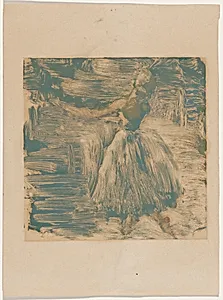
Ballerina
c. 1890s
Medium
monotype printed in blue-green and yellow-green on tan wove paper
Dimensions
image: 19.8 × 19.8 cm (7 13/16 × 7 13/16 in.) sheet: 31.5 × 23.2 cm (12 3/8 × 9 1/8 in.)
Classification
Department
CG-E
Museum
National Gallery of Art, Washington, D.C.
Credit
Gift of James A. Bergquist, Boston, in honor of Shelley R.Langdale
Accession Number
2020.149.34
Rights
Public Domain
Art Historical Context
Henri Eugène Le Sidaner’s *Ballerina*, created around the 1890s, captures the graceful essence of dance through an innovative printmaking technique. This monotype—inked directly onto a plate and transferred in a single pull to tan wove paper—features subtle layers of blue-green and yellow-green, evoking a dreamy, atmospheric glow. Measuring just under 8 inches square, the intimate image reflects the French artist’s fascination with light and mood, hallmarks of his Intimist style, which emphasized quiet, personal moments over grand narratives. Le Sidaner, active during the fin-de-siècle era when Paris buzzed with ballet culture—from Degas’s backstage scenes to the Opéra’s luminaries—produced this work amid Post-Impressionist experimentation. Monotypes like this allowed painterly freedom rare in traditional prints, blending drawing’s spontaneity with printing’s reproducibility, though each impression remains unique. The earthy tan paper grounds the cool greens, suggesting twilight or stage fog, heightening the ballerina’s ethereal poise. Now housed in the National Gallery of Art’s print collection (gift of James A. Bergquist in honor of Shelley R. Langdale), *Ballerina* invites visitors to ponder dance’s fleeting beauty. It exemplifies how late 19th-century artists transformed everyday subjects into poetic visions, bridging painting and print in subtle, seductive hues.