
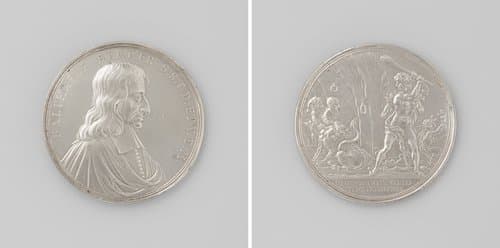
Balthasar Bekker, predikant te Amsterdam, door de synode te Alkmaar afgezet
1698
Medium
striking (metalworking)
Dimensions
4.9; 45.8
Rights
Public Domain
About this artwork
Gift of J.M. van Gelder-Nijhoff
Art Historical Context
This intriguing struck medal from 1698 commemorates Balthasar Bekker, a prominent Dutch preacher in Amsterdam who faced ecclesiastical controversy. Titled *Balthasar Bekker predikant te Amsterdam door de synode temaar afgezet* ("Balthasar Bekker, preacher in Amsterdam, deposed the synod in Alkmaar"), it a pivotal moment in Bekker's life. Measuring just 4.9 cm in and weighing 45.8 grams, this small metalwork piece was likely produced as a jeton or medalet—common in the Dutch Golden Age for marking personal or satirical events. Bekker (1634–1698) gained notoriety for his 1691 book *De Betoverde Weereld* (The Enchanted World), which skeptically challenged beliefs in witchcraft and demons, sparking fierce debates within the Reformed Church. His deposition by the Alkmaar synod reflected broader tensions between rationalism and religious orthodoxy in late 17th-century Netherlands, a time when the Dutch Republic was a hub for intellectual freedom amid theological strife. Crafted anonymously using the striking technique—where a die stamps intricate designs into metal—this medal exemplifies accessible commemorative art. Its modest size made it ideal for circulation or collection, blending historical record with subtle commentary. A generous gift from J.M. van Gelder-Nijhoff, it invites us to ponder the era's clashes between faith and reason.
About the Artist
anonymous
In the vast tapestry of art history, "Anonymous" stands not as a singular individual but as a collective designation for countless unidentified creators whose works have endured across millennia. These artists, spanning prehistoric cave painters to medieval illuminators and folk craftsmen, produced the foundational layers of human visual culture. Prior to the Renaissance, when individual fame emer...