
Band Fragment
1000-1476
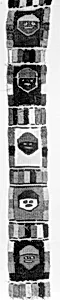
Medium
Slit tapestry
Dimensions
33.7 × 4.1 cm (13 1/4 × 1 5/8 in.)
Classification
textile
Department
Textiles
Museum
Art Institute of Chicago
Accession Number
84995
Rights
Public Domain
Art Historical Context
This delicate *Band Fragment* from the Tiwanaku culture (ca. 1000–1476 CE) offers a rare glimpse into the sophisticated textile artistry of the ancient Andes. Tiwanaku, a powerful pre-Inca civilization centered near Lake Titicaca in modern-day Bolivia, produced textiles that symbolized status, ritual, and cosmology. Measuring just 33.7 × 4.1 cm, this narrow band—likely part of a larger garment or ceremonial object—survived thanks to the dry Andean climate, making it a precious artifact in the Art Institute of Chicago's Textiles collection. Crafted in slit tapestry, a technique where weft yarns create distinct color blocks separated by slits, the fragment showcases the precision of Andean weavers. This method allowed for vibrant geometric patterns and motifs, often evoking Tiwanaku's iconic staff-bearing deities or interlocking designs that reflected the culture's worldview of harmony between earth and sky. Slit tapestry was labor-intensive, reserved for elite contexts, highlighting women's vital role as skilled artisans in Tiwanaku society. Today, this fragment underscores the enduring legacy of Andean textiles, which influenced later Inca weaving. It invites visitors to marvel at how portable art conveyed power and spirituality across vast empires, bridging the pre-Columbian past to our global appreciation of craft mastery.