
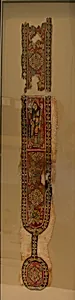
Band with Figures
Unknown Artist
7th–11th century
Medium
Wool, linen; plain weave, tapestry weave
Dimensions
Max. H. 29 1/8 in. (74 cm) Max. W. 3 3/4 in. (9.5 cm)
Classification
Textiles
Department
Islamic Art
Museum
Metropolitan Museum of Art, New York, NY
Credit
Gift of George F. Baker, 1890
Accession Number
90.5.815
Rights
Public Domain
Tags
Art Historical Context
This slender textile band, titled *Band with Figures*, hails from the Islamic world between the 7th and 11th centuries, a golden era of cultural flourishing under the Umayyad andid caliphates. Crafted from wool and linen using plain and tapestry weaves, it measures just 29 inches long and under 4 inches wide, suggesting it served as a decorative border for garments, furnishings, or ceremonial textiles. Donated to the Metropolitan Museum of Art 1890 by George. Baker, it now resides in the Islamic Art department, offering a rare glimpse into early Islamic textile artistry. The band's tapestry weave technique is particularly noteworthy: colored weft yarns completely cover the warp threads, enabling vibrant, detailed patterns without a visible ground fabric. This method, prized in Islamic workshops from Central Asia to the Mediterranean, allowed for intricate figural designs—here featuring men in dynamic poses—that reflect the era's secular artistic traditions. While religious Islamic art often favored abstraction, textiles like this embraced human forms, possibly drawing from pre-Islamic Persian or Byzantine influences, highlighting textiles' role in daily life, trade, and status. As a survivor of over a millennium, this fragment underscores the technical mastery and cultural exchange of medieval Islamic societies, where such bands adorned elite clothing and symbolized wealth. Visitors can appreciate how everyday materials wove stories of human connection across centuries.