
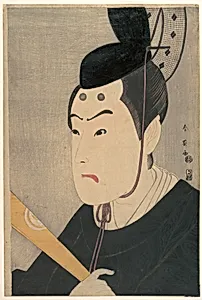
Bando Hikosaburo III as Sugawara no Michizane, from the Kabuki play, "Sugawara's Secrets of Calligraphy" (Sugawara Denju Tenarai Kagami)
ca. 1800
Medium
Woodblock print; ink and color on paper
Dimensions
15 1/4 x 10 1/4 in. (38.7 x 26 cm)
Classification
Prints
Culture & Period
Japan · Edo period (1615–1868)
Department
Asian Art
Museum
Metropolitan Museum of Art, New York, NY
Credit
Henry L. Phillips Collection, Bequest of Henry L. Phillips, 1939
Accession Number
JP2824
Rights
Public Domain
Tags
Art Historical Context
In the vibrant world of Edo-period Japan (1615–1868), Katsukawa Shun'ei, a of the ukiyo-e tradition from the Katsukawa school, captured the theatrical energy of Kabuki in this striking woodblock print. Titled *Bando Hikosaburo III as Sugawara Michizane* from the beloved play *Sugawara's Secrets of Calligraphy*Sugawara Denju Tenai Kagami), it portrays the actor in the role of the legendary scholar-poet Sugawara no Michizane, a historical figure deified as the god of calligraphy and learning. Created around 1800, the print showcases Shun'ei's skill in yakusha-e—actor portraits that immortalized Kabuki stars for everyday fans. Woodblock printing, using ink and color on paper, was a revolutionary medium that democratized art, allowing mass production of affordable, vividly hued images measuring about 15¼ x 10¼ inches. Shun'ei employed dynamic poses, expressive facial details, and bold lines to convey the actor's dramatic intensity, reflecting Kabuki's blend of history, myth, and spectacle. These prints were cultural touchstones, pasted in homes or collected as souvenirs, bridging theater and visual art. This piece from the Metropolitan Museum of Art's Henry L. Phillips Collection highlights Japan's "floating world" (ukiyo) fascination with fleeting pleasures like performance, offering visitors a window into 19th-century urban life and the enduring allure of storytelling through art.
About the Artist
Katsukawa Shun'ei 勝川春英 (Japanese) · 1762 –1819
Japanese, 1762–1819