
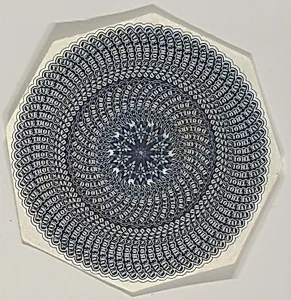
Banknote motif: a circular lathe work design composed out of the repetition of the words "Five thousand dollars"
Medium
Engraving, printed in blue ink; proof
Dimensions
octagonal sheet: 2 1/2 x 2 1/2 in. (6.4 x 6.4 cm)
Classification
Prints
Department
Drawings and Prints
Museum
Metropolitan Museum of Art, New York, NY
Credit
Gift of Joseph Veach Noble, 2002
Accession Number
2002.333.57
Rights
Public Domain
Art Historical Context
This exquisite engraving from the Metropolitan Museum of Art showcases a delicate circular lathe-work design created by Cyrus Durand and his associated firms, A. B. & C. Durand & Company and Durand, Perkins, and Company, around 1824–42. The tiny octagonal proof, measuring just 2½ inches across and printed in blue ink, repeats the words “Five thousand dollars” in an intricate geometric pattern. Such motifs were intended as security features for banknotes, transforming simple text into mesmerizing, hard-to-replicate ornament. Durand was a pioneering figure in American engraving, perfecting the use of the rose-engine lathe to produce guilloche patterns that defeated counterfeiters. This proof represents an early stage in that process, allowing printers to test the design’s clarity and complexity before committing it to currency. Its small scale and pristine condition highlight the extraordinary precision required of nineteenth-century engravers. Today the piece offers visitors a fascinating glimpse into the intersection of art and industry, reminding us how beauty and technical ingenuity once protected everyday objects like paper money.
About the Artist
A. B. & C. Durand & Company|Durand, Perkins, and Company|Cyrus Durand (American|American|American) · 1824 |1796 |1787 –1832 |1886 |1868
American, active 1824–32|American, Jefferson, New Jersey 1796–1886 Maplewood, New Jersey|American, 1787–1868