
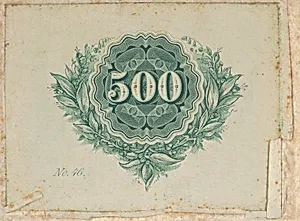
Banknote motif: number 500 at the center of a circular design of lathe work with wavy edges, surrounded by an open wreath of leaves, berries and flowers
Medium
Engraving and etching, printed in green ink; proof
Dimensions
plate: 2 7/16 x 3 1/4 in. (6.2 x 8.2 cm) sheet: 6 1/16 x 3 15/16 in. (15.4 x 10 cm)
Classification
Prints
Department
Drawings and Prints
Museum
Metropolitan Museum of Art, New York, NY
Credit
Gift of Joseph Veach Noble, 2002
Accession Number
2002.333.38
Rights
Public Domain
Tags
Art Historical Context
This intricate engraving and etching, created around 1824–42 by Cyrus Durand and the firm A. B. & C. Durand & Company (also known as Durand, Perkins, and Company), served as a proof for a banknote motif featuring the denomination 500. At its center lies a precise circular lathe-work pattern with wavy edges, encircled by a delicate open wreath of leaves, berries, and flowers—all printed in green ink. Such designs were essential in the early nineteenth century, when paper currency required elaborate security features to deter counterfeiting. Durand’s innovations in mechanical engraving tools allowed for the complex geometric patterns seen here, which were nearly impossible to replicate by hand. The small scale of the plate (just over two by three inches) highlights the remarkable precision required for these proofs, which were often submitted to banks for approval before full production. Housed in the Metropolitan Museum’s Department of Drawings and Prints, this work offers a fascinating glimpse into the intersection of art and finance during America’s expanding banking era. Its combination of mechanical intricacy and organic motifs reflects both technological progress and the desire to imbue everyday currency with aesthetic appeal.
About the Artist
A. B. & C. Durand & Company|Durand, Perkins, and Company|Cyrus Durand (American|American|American) · 1824 |1796 |1787 –1832 |1886 |1868
American, active 1824–32|American, Jefferson, New Jersey 1796–1886 Maplewood, New Jersey|American, 1787–1868