
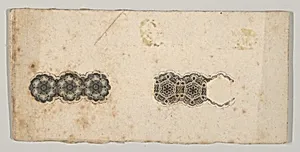
Banknote motif: two bands of ornamental lathe work resembling florets and hexagons
Medium
Engraving; proof
Dimensions
sheet: 2 13/16 x 1 5/16 in. (7.2 x 3.4 cm)
Classification
Prints
Department
Drawings and Prints
Museum
Metropolitan Museum of Art, New York, NY
Credit
Gift of Joseph Veach Noble, 2002
Accession Number
2002.333.49
Rights
Public Domain
Tags
Art Historical Context
This delicate engraving from the Metropolitan Museum of Art showcases a banknote motif created by Cyrus Durand and his firm, A. B. & C. Durand & Company (later Durand, Perkins, and Company), between 1824 and 1842. Measuring just over two inches tall, the proof features two precise bands of ornamental lathe work—intricate patterns of florets and hexagons produced by a geometric lathe. Such proofs allowed engravers to test and refine designs before they appeared on actual currency. In the early nineteenth century, American banks relied on specialized engravers to combat widespread counterfeiting. Durand’s innovative lathe created complex, repeating geometric designs that were nearly impossible to replicate by hand, adding both security and beauty to paper money. These tiny, machine-generated motifs became a hallmark of American banknote production during a period of rapid economic growth and expanding financial institutions. Though small in scale, this engraving highlights the intersection of art, technology, and commerce. The crisp lines and symmetrical forms demonstrate the precision of early industrial engraving techniques, transforming functional security features into miniature works of art that still fascinate viewers today.
About the Artist
A. B. & C. Durand & Company|Durand, Perkins, and Company|Cyrus Durand (American|American|American) · 1824 |1796 |1787 –1832 |1886 |1868
American, active 1824–32|American, Jefferson, New Jersey 1796–1886 Maplewood, New Jersey|American, 1787–1868