
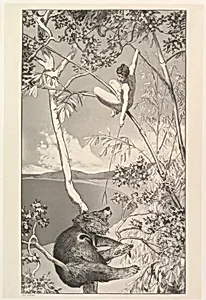
Bär und Elfe, from the series Intermezzi
n.d.
Dimensions
Sheet: 16 5/16 in. × 11 in. (41.4 × 28 cm)
Classification
Prints
Department
Drawings and Prints
Museum
Metropolitan Museum of Art, New York, NY
Credit
Gift of the Estate of Mrs. Edward Robinson, 1952
Accession Number
52.594.23
Rights
Public Domain
Tags
Art Historical Context
In the enchanting print *B und Elfe* (Bear and Elf), Max Klinger's series *Intermez*, a fantastical encounter between a majestic bear and a delicate female nude—likely the "elfe" or of the title—amidst a wooded landscape of trees. This evocative image, measuring 16 5/16 × inches, captures Klinger's mastery the graphic arts, blending the mythical with the sensual in a dreamlike composition. Produced as part of his *Intermezzi* series it exemplifies the artist's fascination with nature's wildness and human (or) form, evoking sense of whimsical yet intimate. Max Klinger, pioneering German Symbolist active in the late 19th century, elevated printmaking—likely etching here, given his renowned technique—to the level of fine art. His works often drew from Romantic traditions, infusing them with eroticism, fantasy, and psychological depth, influencing later movements like Art Nouveau. *Intermezzi* served as poetic interludes in his oeuvre, showcasing intricate line work that animates fur, flesh, and foliage with startling realism and imagination. Acquired by The Metropolitan Museum of Art in 1952 as a gift from the Estate of Mrs. Edward Robinson, this piece invites visitors to ponder the interplay of beast and beauty, a timeless theme in European art. Step closer to appreciate Klinger's subtle tonal contrasts and narrative intrigue.
About the Artist
Max Klinger · 1857–1920
Max Klinger, born on February 18, 1857, in Leipzig to a wealthy family, emerged as one of Germany's most innovative artists across painting, sculpture, printmaking, and graphics. Demonstrating early talent, he enrolled at the Academy of Fine Arts in Karlsruhe in 1874 as a pupil of Karl Gussow, following his teacher to the Berlin Academy upon Gussow's appointment as director, and graduated in 1877 ...