
Barberinae Aulae Fornix
1692 - 1762
Medium
engraving
Dimensions
613; 292
Rights
Public Domain
About this artwork
collector's mark: Lugt 240
Art Historical Context
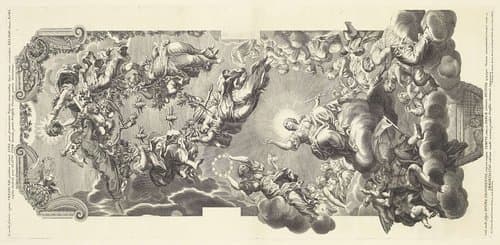
Welcome to our virtual gallery, where we explore the grandeur of Baroque Rome through an exquisite anonymous engraving titled *Barberinae Aulae Fornix*, created between 1692 and 1762. This detailed print, measuring an impressive 613 mm high by 292 mm wide, captures the architectural splendor of the "Arch of the Barberini Court"—likely a triumphal or decorative gateway at the Palazzo Barberini, the opulent residence of one of Rome's most influential families. The Barberini, elevated by Pope Urban VIII in the 17th century, were renowned patrons of the arts, commissioning masterpieces from Bernini and Pietro da Cortona that defined the High Baroque style. Engravings like this were vital in the era, serving as precise reproductions that allowed the elite across Europe to "collect" Rome's monuments without leaving home. The technique involved incising intricate lines into a copper plate, inking it, and pressing paper to create rich, tonal images—perfect for conveying the dramatic perspectives and ornate details of grand architecture. This veduta (view) reflects the growing fascination with topographic accuracy during the late Baroque and Rococo periods. Bearing the collector's mark Lugt 240, a stamp from a distinguished 18th- or 19th-century connoisseur's collection, this work underscores its enduring value. Step closer and imagine the bustling Roman courtyard it evokes—a testament to enduring legacy preserved in ink and paper.
About the Artist
anonymous
In the vast tapestry of art history, "Anonymous" stands not as a singular individual but as a collective designation for countless unidentified creators whose works have endured across millennia. These artists, spanning prehistoric cave painters to medieval illuminators and folk craftsmen, produced the foundational layers of human visual culture. Prior to the Renaissance, when individual fame emer...