
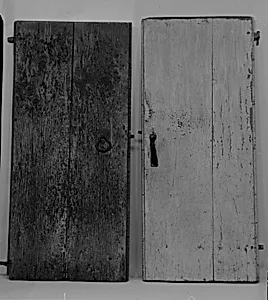
Batten Door from the Williams House, near Preston, Connecticut
Unknown Artist
1670–1700
Medium
Pine
Dimensions
74 x 31 in. (188 x 78.7 cm)
Classification
Door
Culture
American
Department
The American Wing
Museum
Metropolitan Museum of Art, New York, NY
Credit
Rogers Fund, 1937
Accession Number
37.96.2
Rights
Public Domain
Tags
Art Historical Context
Step into the humble world of 17th-century New England with this remarkable batten door from the House near Preston, Connecticut, crafted between 1670 and 1700. Made of pine—a readily available local wood—this sturdy door measures 74 x 31 inches exemplifies the practical ingenuity of early colonial builders. With an unknown artist, it vernacular craftsmanship rather than high art, using simple vertical planks nailed to horizontal battens for strength and stability, a technique suited to the limited tools of frontier settlers. In colonial Connecticut, such doors were essential for homes like the Williams House, shielding families from harsh winters and wildlife while embodying Puritan simplicity. Pine's softness allowed for hand-hewing or pit-sawing, techniques that prioritized function over ornament, highlighting the resourcefulness of American pioneers adapting European traditions to the New World. Today, housed in The Metropolitan Museum of Art's American Wing (acquired via the Rogers Fund in 1937), this door offers a tangible link to everyday life in early America. It whispers stories of resilience, community, and the birth of a distinct colonial aesthetic, inviting us to appreciate the artistry in utility.