
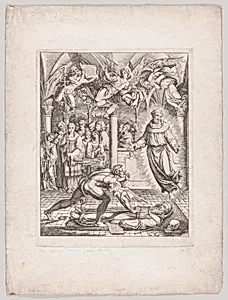
Battle of Satan with St. Francis for the Soul of the Monk Guido of Montefeltro
1807–8
Medium
Etching
Dimensions
Sheet: 23 1/8 × 17 5/16 in. (58.7 × 44 cm) Plate: 15 11/16 × 12 1/2 in. (39.9 × 31.7 cm)
Classification
Prints
Department
Drawings and Prints
Museum
Metropolitan Museum of Art, New York, NY
Credit
Purchase, Daniel Ergmann Gift, 2014
Accession Number
2014.126
Rights
Public Domain
Tags
Art Historical Context
In the Metropolitan Museum of Art's Drawings and Prints department, Joseph Anton Koch's etching * of Satan with St. for the Soul of the Guido of Montefeltro (1807–8) vividly dramatizes a pivotal episode from Dante Alighieri's *Infer* (Canto XXVII). Here, the nobleman and Franciscan tertiary Guido di Montefeltro damned for deceitful counsel to Pope Boniface VIII, becomes the contested prize in a celestial tug-of-war. Saint Francis arrives with angels to claim Guido's soul for salvation, only to face Satan's fierce resistance—a poignant reminder of redemption's fragility in medieval theology. Koch, an Austrian-born artist active in Rome during the Napoleonic era, masterfully employs etching's incisive lines to convey dynamic movement and emotional intensity. Trained in history painting and landscape, he infuses this religious narrative with early Romantic vigor, heightening the supernatural drama through swirling forms and stark contrasts. The large plate (15⅝ × 12½ inches) allowed for intricate detail, showcasing etching's potential for expressive depth beyond mere reproduction. Acquired through the Daniel Ergmann Gift in 2014, this work highlights Koch's versatility bridging Neoclassicism and emerging Romanticism, inviting visitors to ponder the eternal struggle between divine mercy and infernal claim.
About the Artist
Joseph Anton Koch · 1768–1839
Joseph Anton Koch, born on July 27, 1768, in the remote Tyrolean village of Elbigenalp, Austria, grew up tending his family's sheep amid the dramatic Alpine landscapes that would later define his art. At age 15, Bishop Umgelder recommended him for formal training, leading to studies at the Catholic seminary in Dillingen, with a court sculptor in Augsburg, and finally at the prestigious Hohe Karlss...