
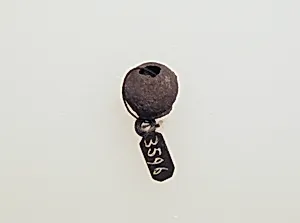
Bead
Unknown Artist
Medium
Silver
Dimensions
Diameter: 3/8 × 3/8 in. (1 × 0.9 cm)
Classification
Gold and Silver
Department
Greek and Roman Art
Museum
Metropolitan Museum of Art, New York, NY
Credit
The Cesnola Collection, Purchased by subscription, 1874–76
Accession Number
74.51.3596
Rights
Public Domain
Art Historical Context
This delicate silver bead, measuring just 3/8 × 3/8 inches, exemplifies the exquisite craftsmanship of the ancient Greek and Roman world. Housed in the Metropolitan Museum of Art's Department of Greek and Roman Art and classified among gold and silver artifacts, it invites us to marvel at the precision required to fashion such a tiny object from precious metal. Though its exact date and artist remain unknown, its inclusion in The Cesnola Collection—purchased by subscription between 1874 and 1876—links it to one of the Museum's foundational acquisitions. Assembled by Luigi Palma di Cesnola, an Italian-American archaeologist and Civil War veteran, the collection primarily features Cypriot antiquities from the Bronze Age through the Hellenistic period. Cyprus, a cultural crossroads between Greece, the Near East, and Egypt, produced jewelry like this bead, often strung into necklaces, bracelets, or decorative trims. Silver, valued for its luster and relative abundance compared to gold, was hammered, cast, or pierced with fine tools, showcasing metallurgical skills honed over millennia. Today, this unassuming bead whispers of ancient daily life—perhaps adorning a wealthy merchant's garment or a child's amulet. It reminds visitors that grandeur in antiquity often lay in the intimate and functional, bridging personal adornment with broader networks of trade and artistry. A testament to enduring human ingenuity!