
Bead
Unknown Artist
8th–13th century
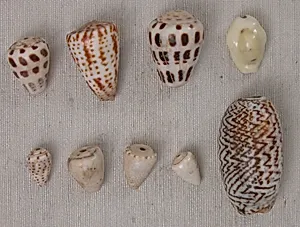
Medium
Shell
Dimensions
48.101.208a: W. 7/16 in. (1.1 cm) D. 3/8 in. (1 cm) L. 5/8 in. (1.6 cm)
Classification
Jewelry
Department
Islamic Art
Museum
Metropolitan Museum of Art, New York, NY
Credit
Rogers Fund, 1948
Accession Number
48.101.208a
Rights
Public Domain
Art Historical Context
This delicate shell bead, dating from the 8th to 13th century, offers a glimpse into the everyday artistry of the Islamic world. Crafted from a single piece of shell—likely sourced from coastal regions of the Indian Ocean or Red—it measures a modest 5/8 inch in length, with a width of 7/16 inch and depth of 38 inch. As a piece of jewelry classified in the Metropolitan Museum of Art's Islamic Art department, it exemplifies the simple yet elegant adornments worn by people across the vast Abbasid and Fatimid empires. Shell was a prized medium in Islamic jewelry-making due to its natural luster, durability, and availability through extensive trade networks that connected the Middle East, North Africa, and beyond. Artisans skillfully drilled a central hole for stringing into necklaces, bracelets, or prayer beads, polishing the surface to enhance its iridescent sheen. Such beads were not only decorative but also practical, symbolizing prosperity and protection in daily life. Acquired through the Rogers Fund in 1948 (accession 48.101.208a), this unassuming artifact highlights the ingenuity of anonymous craftsmen whose work fueled cultural exchange. Visitors to the Met can appreciate how even the smallest objects reveal the richness of Islamic material culture during a golden age of innovation and interconnectedness.