
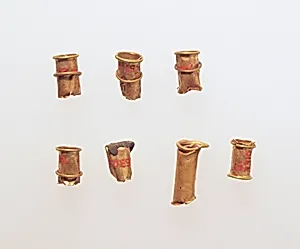
Bead, tubular
Unknown Artist
Medium
Gold
Dimensions
Diameter: 1/4 x 9/16 in. (0.7 x 1.4 cm)
Classification
Gold and Silver
Culture
Cypriot
Department
Greek and Roman Art
Museum
Metropolitan Museum of Art, New York, NY
Credit
The Cesnola Collection, Purchased by subscription, 1874–76
Accession Number
74.51.3307
Rights
Public Domain
Art Historical Context
This delicate tubular gold bead, hailing from ancient Cyprus, exemplifies the exquisite craftsmanship of Cypriot artisans in the Greek and Roman world. Measuring just a quarter-inch in diameter and nine-sixteenths of an inch long, its petite scale belies its cultural weight. Cyprus, a strategic island in the eastern Mediterranean, was a vibrant crossroads of trade and influence from the Bronze Age through the Classical period, blending Greek, Phoenician, and Near Eastern styles. Such beads were likely strung into necklaces, earrings, or ceremonial adornments, symbols of wealth and status for elites. Crafted from pure gold—a precious metal sourced through Cyprus's prosperous mining trade—the bead showcases advanced metalworking techniques, possibly involving sheet gold hammered and seamed into a tube or drawn wire. Its simple yet elegant form highlights the precision required for such miniature jewelry components, which were mass-produced yet finely finished. Acquired as part of The Cesnola Collection—assembled by diplomat Luigi Palma di Cesnola and purchased by subscription for the Metropolitan Museum of Art between 1874 and 1876—this artifact offers a tangible link to Cyprus's enigmatic past. Today, in the Met's Greek and Roman Art department, this unassuming bead invites us to marvel at everyday luxuries of antiquity, reminding visitors of how small objects can illuminate grand histories of innovation and exchange.