
Beads, 3
Unknown Artist
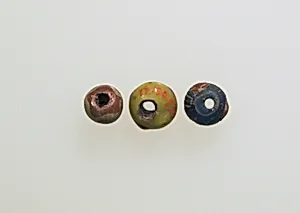
Medium
Glass
Dimensions
Diameter (Bead 1): 3 13/16 in. (9.7 cm) Diameter (Bead 2): 3 3/8 in. (8.6 cm) Diameter (Bead 3): 3 1/16 in. (7.7 cm)
Classification
Glass
Culture
Roman
Department
Greek and Roman Art
Museum
Metropolitan Museum of Art, New York, NY
Credit
Gift of J. Pierpont Morgan, 1917
Accession Number
17.194.550
Rights
Public Domain
Art Historical Context
These three remarkable glass beads, simply titled *Beads, 3*, offer a glimpse into the everyday artistry of ancient Rome. Crafted from—a medium the Romans mastered through innovative techniques like core-forming and mold-blowing—these spheres vary in size, with diameters ranging from 3 /16 inches (7.7 cm) to 3 13/16 inches (9.7 cm). Their substantial dimensions suggest they were not mere trinkets but possibly components of grand necklaces, ceremonial ornaments, or trade goods, showcasing the precision and transparency that defined Roman glasswork from the 1st century BCE onward. In the context of Roman culture, glass beads like these were ubiquitous, adorning everything from elite jewelry to amulets for protection against evil. Roman artisans achieved vibrant colors and clarity by mixing silica with soda and lime, firing it in specialized furnaces—a technological leap that made glass affordable and exportable across the empire. Though the exact date and creator remain unknown, their presence in the Metropolitan Museum of Art's Greek and Roman Art department highlights their role in daily life and commerce. A generous gift from financier J. Pierpont Morgan in 1917, these beads connect us to Rome's inventive spirit, reminding visitors how simple objects encapsulated a civilization's ingenuity and aesthetic sensibility.