
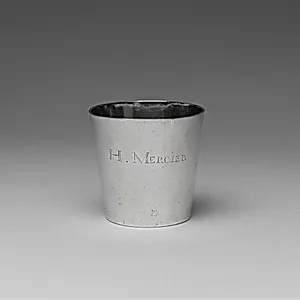
Beaker
ca. 1800
Medium
Silver
Dimensions
Overall: H. 2 7/16 in. (6.2 cm); 3 oz. 19 dwt. (123.3 g) Lip: Diam. 2 5/8 in. (6.7 cm) Base: Diam. 2 15/16 in. (7.4 cm)
Classification
Beaker
Culture
American
Department
The American Wing
Museum
Metropolitan Museum of Art, New York, NY
Credit
Bequest of Alphonso T. Clearwater, 1933
Accession Number
33.120.102
Rights
Public Domain
Art Historical Context
This elegant silver beaker, crafted around 1800 by Laurent Amyot (also spelled Amiot), represents the refined metalworking traditions of early American artisans. Standing just over two inches tall and weighing about four ounces, its compact form—with a gently flared lip and stable base—suggests it was designed for personal or ceremonial use, such as drinking toasts or serving small portions of wine or spirits. As a product of the American Wing’s collection, it reflects the period’s blend of European influences and emerging American craftsmanship. Silver held particular significance in the early nineteenth century as both a practical and status symbol. Artisans like Amyot employed time-honored techniques such as raising, hammering, and finishing by hand to create durable yet graceful objects that could be passed down through generations. The beaker’s modest scale and pure material highlight the era’s emphasis on functional beauty, where everyday items doubled as displays of wealth and skill. Acquired by the Metropolitan Museum through the 1933 bequest of Alphonse T. Clearwater, this piece offers visitors a tangible connection to the domestic rituals and artistic achievements of America’s formative years. Its survival speaks to the enduring value placed on well-made silverware across centuries.