
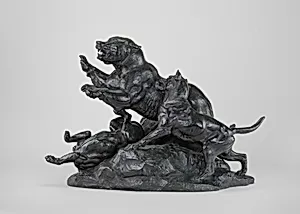
Bear Fleeing from Dogs
model n.d., cast after 1870 by 1873
Medium
bronze
Dimensions
overall: 35.56 × 45.09 × 25.4 cm (14 × 17 3/4 × 10 in.)
Classification
Sculpture
Department
CSD
Museum
National Gallery of Art, Washington, D.C.
Credit
Corcoran Collection (Museum Purchase)
Accession Number
2015.19.3859
Rights
Public Domain
Art Historical Context
Antoine-Louis Barye *Bear Fleeing from*, a dynamic bronze sculpture cast after 1870 from an undated model, captures the raw intensity of the animal kingdom. Measuring 14 × 17¾ × 10 inches, this work depicts a powerful bear in mid-escape, pursued by snarling hounds—a scene brimming with tension and motion. Barye, a leading 19th-century French sculptor and pioneer of the *animalier* genre, in naturalistic renderings of wildlife, blending Romantic drama with meticulous anatomical precision. Renowned for his bronze masterpieces, Barye revolutionized animal sculpture by drawing directly from live studies at the Paris Jardin des Plantes zoo. The lost-wax casting technique used here allowed for intricate details in fur texture, muscle strain, and expressive faces, enhanced by the medium’s rich patina over time. This piece reflects the era’s fascination with nature’s ferocity amid industrialization, showcasing Barye’s mastery in evoking empathy for beasts in peril. Part of the Corcoran Collection at the National Gallery of Art, *Bear Fleeing from Dogs* invites visitors to ponder the wild’s untamed spirit, a timeless testament to Barye’s enduring legacy in sculpture.
About the Artist
Antoine-Louis Barye · 1795–1875
Antoine-Louis Barye (1795–1875) was born in Paris on September 24, the son of goldsmith Pierre Barye and Marguerite Barye. Following family tradition, he apprenticed as a goldsmith under his father and, around 1810, with Martin-Guillaume Biennais, goldsmith to Napoleon. After brief military service, Barye pursued sculpture, studying under François-Joseph Bosio in 1816 and painter Baron Antoine-Jea...