
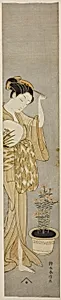
Beauty Adjusting her Hairpin
c. 1768/69
Medium
Color woodblock print; hashira-e
Dimensions
62.2 × 12.1 cm (24 5/8 × 4 3/4 in.)
Classification
woodblock print
Department
Arts of Asia
Museum
Art Institute of Chicago
Accession Number
22982
Rights
Public Domain
Art Historical Context
**Beauty Adjusting her Hairpin is a captivating color woodblock print by Suzuki Harunobu created around 1768/69. Harunobu, a pioneering ukiyo-e artist from Japan's Edo period (1603–1868), revolutionized printmaking by introducing full-color *nishiki-e* (brocade pictures) in 1765. This *hashira-e*—a tall, narrow pillar print measuring 62.2 × 12.1 cm—was designed to hang gracefully on architectural pillars in homes or teahouses, blending art seamlessly into daily life. The intimate scene depicts a graceful beauty pausing to adjust her hairpin, embodying the *bijin-ga* (pictures of beautiful women) genre that celebrated feminine elegance and subtle sensuality. Harunobu's mastery shines in his delicate lines, vibrant hues achieved through multiple woodblocks, and soft, atmospheric shading (*fuki-bokashi*), evoking a dreamy, poetic mood. These techniques captured the fleeting beauty of urban life in Edo (modern Tokyo), appealing to a growing merchant class. Housed in the Art Institute of Chicago's Arts of Asia department, this print highlights Harunobu's enduring influence on Japanese woodblock art, bridging everyday moments with timeless artistry. Visitors will appreciate its vertical elegance, a window into 18th-century Japan's refined aesthetic world.
About the Artist
Suzuki Harunobu · 1725–1770
Suzuki Harunobu (c. 1725-1770) was a Japanese ukiyo-e artist who revolutionized woodblock printing by developing nishiki-e—full-color prints using multiple woodblocks—in 1765. Before Harunobu, Japanese prints were limited to two or three colors; his innovation unleashed the entire artist's palette, transforming ukiyo-e into the vibrant art form that would later captivate Western artists from Manet...