
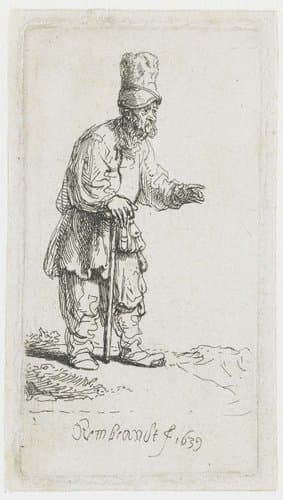
Bedelaar met hoge muts, leunend op een stok
Medium
etching
Dimensions
84; 44
Rights
Public Domain
About this artwork
mark: Lugt 2228
Art Historical Context
In the heart of the Dutch Golden Age Rembrandt van Rijn crafted *Bedelaar met hoge mut, leunend op een stok* (Beggar with Tall Hat, Leaning on Stick) in 1639, a poignant etching measuring just 84 mm high by 44 mm wide. This intimate print captures a weathered beggar in a tall, conical hat, stooped and leaning on a staff, embodying Rembrandt's fascination with the human condition. During his prolific Amsterdam years, Rembrandt produced a series of beggar studies, drawing from the streets of 17th-century Holland to highlight the dignity amid poverty, a theme resonant in a prosperous era marked by trade wealth and social contrasts. Rembrandt's mastery of etching shines here: using fine lines and subtle burr from drypoint, he achieves extraordinary depth and texture in this tiny format. The play of light on the beggar's furrowed face and ragged clothes creates a dramatic chiaroscuro, a hallmark of his Baroque style, evoking empathy and realism. Prints like this were affordable art for a wide audience, revolutionizing graphic reproduction and allowing Rembrandt's genius to reach beyond elite patrons. Bearing the collector's mark Lugt 2228, this work exemplifies Rembrandt's innovative printmaking, blending technical virtuosity with profound humanism. A gem for any visitor, it invites reflection on resilience and the artist's empathetic gaze.
About the Artist
Rembrandt van Rijn · 1606–1669
Rembrandt Harmenszoon van Rijn (1606–1669) stands as one of the greatest visual artists in the history of Western art and the most important Dutch painter of the 17th century. Born in Leiden to a prosperous miller's family, Rembrandt transformed painting through his revolutionary use of light and shadow, his psychological depth in portraiture, and his elevation of etching to a fine art. His approx...