
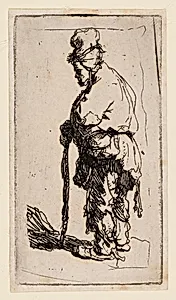
Beggar Leaning on a Stick, Facing Left
c. 1630
Medium
Etching on ivory laid paper
Dimensions
Plate: 8.5 × 4.7 cm (3 3/8 × 1 7/8 in.); Sheet: 8.8 × 5 cm (3 1/2 × 2 in.)
Classification
etching
Department
Prints and Drawings
Museum
Art Institute of Chicago
Accession Number
29071
Rights
Public Domain
Art Historical Context
In the early 1630s, as Rembrandt van Rijn was emerging as one of the Dutch Golden Age's greatest masters, he created *Beggar Leaning on a Stick, Facing Left*, an intimate etching capturing the quiet dignity of a weary figure from society's margins. Produced around 1630, when Rembrandt was in his mid-20s and honing his craft in Leiden before his rise in Amsterdam, this small work (just 8.5 × 4.7 cm) reflects his fascination with everyday people—beggars, tramps, and laborers—often portrayed with empathy rather than pity, humanizing those overlooked in 17th-century Dutch society. Rembrandt's genius shines in his etching technique, where he drew intricate lines into a copper plate with a needle, allowing acid to bite the grooves for inking and printing. On ivory laid paper, he masterfully employed cross-hatching and subtle drypoint scratches to evoke texture—the rough stick, tattered clothes, and shadowed face—achieving a dramatic chiaroscuro that brings depth and emotion to this tiny scale. These innovations made his prints rival paintings in expressiveness, influencing generations of artists. Housed in the Art Institute of Chicago's Prints and Drawings Department, this etching exemplifies Rembrandt's prolific output of over 300 prints, prized today for their technical brilliance and social insight. It invites visitors to ponder the humanity in hardship, a timeless theme from the Baroque era.
About the Artist
Rembrandt van Rijn · 1606–1669
Rembrandt Harmenszoon van Rijn (1606–1669) stands as one of the greatest visual artists in the history of Western art and the most important Dutch painter of the 17th century. Born in Leiden to a prosperous miller's family, Rembrandt transformed painting through his revolutionary use of light and shadow, his psychological depth in portraiture, and his elevation of etching to a fine art. His approx...