
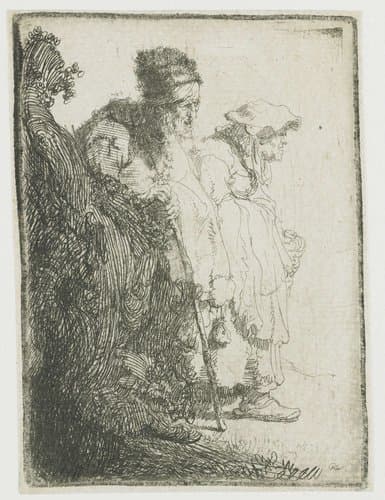
Beggar man and woman behind a bank
c. 1630
Medium
etching
Dimensions
84; 116
Rights
Public Domain
About this artwork
hoogte 116 mm (onregelmatige plaatrand) x breedte 84 mm
Art Historical Context
In the early 163s, Rembrandt van R, the eminent Dutch Baroque master, captured the poignant lives of the marginalized in his etching *Beggar Man and Woman Behind a Bank* (c. 1630). This intimate work, measuring just 116 mm high by 84 mm wide with an irregular plate edge, Rembrandt's fascination with everyday humanity during the Dutch Golden Age. Produced when he was in his mid-twenties, transitioning from Leiden to Amsterdam, it reflects his early experiments in printmaking amid a booming market for affordable etchings. Rembrandt's etching technique shines here, employing fine lines, cross-hatching, and subtle burr from drypoint to conjure dramatic chiaroscuro—deep shadows enveloping the figures while slivers of light illuminate their weathered faces and tattered clothes. The "bank"—likely a low earthen mound or river embankment—frames the beggars in a humble, naturalistic setting, evoking empathy for society's outcasts. This small-scale intimacy allowed the print to reach wide audiences, democratizing art. As one of Rembrandt's beggar series, it highlights his revolutionary approach to portraiture, blending realism with emotional depth. A testament to his genius, this etching not only advanced print techniques but also immortalized the human spirit's resilience, inviting viewers to ponder compassion across centuries.
About the Artist
Rembrandt van Rijn · 1606–1669
Rembrandt Harmenszoon van Rijn (1606–1669) stands as one of the greatest visual artists in the history of Western art and the most important Dutch painter of the 17th century. Born in Leiden to a prosperous miller's family, Rembrandt transformed painting through his revolutionary use of light and shadow, his psychological depth in portraiture, and his elevation of etching to a fine art. His approx...