
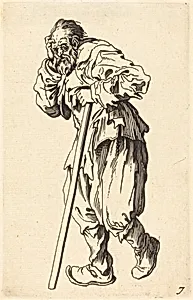
Beggar with a Stick
1622 or later
Medium
etching on laid paper
Dimensions
sheet (trimmed to plate mark): 14 × 9 cm (5 1/2 × 3 9/16 in.)
Classification
Department
CG-E
Museum
National Gallery of Art, Washington, D.C.
Credit
Rosenwald Collection
Accession Number
1949.5.324
Rights
Public Domain
Art Historical Context
**Beggar with a Stick**, an etching on laid paper after the renowned French artist Jacques Callot, dates to 1622 or later. This intimate print, measuring just 14 × 9 cm, captures a solitary beggar clutching a stick, rendered with Callot's signature precision. Trimmed to the plate mark, it exemplifies the compact scale typical of 17th-century etchings designed for wide dissemination among collectors and the public. Jacques Callot (1592–1635) was a master printmaker whose innovative etching techniques produced extraordinarily detailed images in small formats. Working primarily in Italy and France during the Baroque era, he often depicted the gritty realities of social outcasts, blending keen observation with dramatic flair. This work reflects his fascination with the marginalized, offering a poignant glimpse into the hardships of early modern Europe amid economic strife and the Thirty Years' War's shadow. Etched on laid paper—a common support for the period that provided a subtle texture enhancing line work—this piece from the National Gallery of Art's Rosenwald Collection highlights etching's revolutionary potential. Callot's virtuoso use of fine lines and cross-hatching brought unprecedented depth to prints, making art accessible beyond paintings and influencing generations of artists. A humble yet masterful study in human resilience.
About the Artist
after Jacques Callot
**Jacques Callot (c. 1592–1635)**, the master whose designs inspired the works attributed "after Jacques Callot," was a pioneering French Baroque printmaker and draftsman born in Nancy, capital of the independent Duchy of Lorraine (now northeastern France). From a noble family—his father served as master of ceremonies and herald-at-arms to the Duke of Lorraine—young Callot was apprenticed to a gol...