
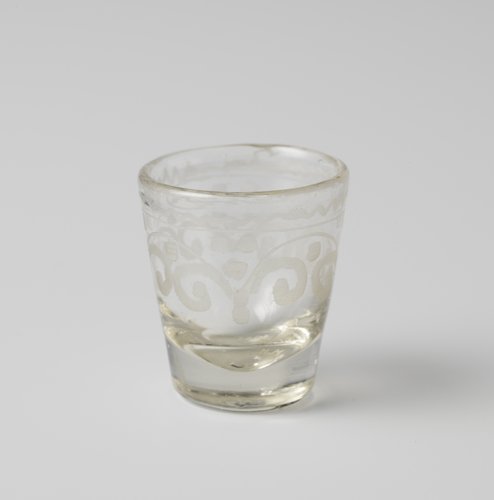
Beker gedecoreerd met gegraveerde zigzagrand boven voluten en bollen
ca. 1750 - ca. 1800
Medium
engraving
Dimensions
3; 3.4
Rights
Public Domain
About this artwork
height 3.4 cm x diameter 3 cm
Art Historical Context
This delicate engraved beaker, titled *Beker gedecore met gegraveerde zigagrand boven voluten bollen*, exemplifies anonymous craftsmanship from the mid-to-late 18th (ca. 1750–1800). Standing just 3.4 cm high with a 3 cm diameter, thisutive cup features a finely etched zigzag border crowning elegant volutes—scroll-like motifs inspired by classical architecture—and spherical bollen (knobs or balls). Such intricate designs transformed everyday objects into miniature works of art, likely intended for personal use, like a traveler's drinking vessel or part of a gentleman's vanity set. Engraving, the medium here, was a prized technique in European metalwork during the Rococo and early Neoclassical eras. Artisans used sharp tools to incise patterns into silver or base metals, creating texture and light play that enhanced the object's appeal. In the Dutch tradition, evident from the title, this method highlighted restraint and precision amid opulent styles elsewhere, reflecting the Enlightenment's taste for refined, functional beauty. Though anonymous, the beaker underscores the vital role of skilled workshops in producing accessible luxury. Its survival speaks to the enduring value of such micro-masterpieces, inviting us to appreciate the patience behind every precise line.
About the Artist
anonymous
In the vast tapestry of art history, "Anonymous" stands not as a singular individual but as a collective designation for countless unidentified creators whose works have endured across millennia. These artists, spanning prehistoric cave painters to medieval illuminators and folk craftsmen, produced the foundational layers of human visual culture. Prior to the Renaissance, when individual fame emer...