
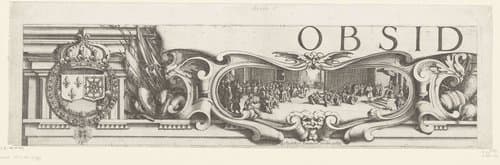
Beleg van La Rochelle, september 1627-oktober 1628 (randwerk, deel linksboven)
1628 - 1631
Medium
etching
Dimensions
609; 161
Rights
Public Domain
About this artwork
verzamelaarsmerk, verso linksonder, gestempeld: Lugt 240
Art Historical Context
Jacques Callot's *Beleg van La Rochelle september 1627-ok 1628 (randwerk, deel linksboven is a captivating etching from 1628–1631, capturing the upper-left border section of a panoramic depiction of the historic Siege of La Rochelle. This French Baroque master printmaker, renowned for his war scenes like *The Miseries and Misfortunes of War*, produced this work amid one of Europe's pivotal conflicts. Measuring just 161 mm high by 609 mm wide, its elongated format immerses viewers in the chaos of battle, showcasing Callot's genius for compressing vast narratives into fine detail. The siege, led by Cardinal Richelieu under Louis XIII, lasted from September 1627 to October 1628 and marked a turning point in France's religious wars. La Rochelle, a Protestant Huguenot stronghold, was starved into surrender, bolstering royal absolutism and weakening Calvinist resistance. Callot's etching, likely part of a larger series, documents this event with vivid realism, blending military strategy, suffering, and spectacle—hallmarks of his empathetic yet unflinching style. Etching allowed Callot to achieve extraordinary precision with tiny figures and bustling compositions, revolutionizing printmaking for storytelling. Bearing a collector's mark (Lugt 240) on the verso, this rare fragment invites us to ponder the human cost of power, making it a poignant gem for any virtual gallery stroll.
About the Artist
Jacques Callot · 1592–1635
Jacques Callot (1592–1635) was a French printmaker and draftsman from the Duchy of Lorraine, widely regarded as one of the first great artists to practice the graphic arts exclusively. His more than 1,400 etchings chronicled the breadth of 17th-century life, from Medici court festivities to the brutal realities of warfare. Callot revolutionized etching through technical innovations including the é...