
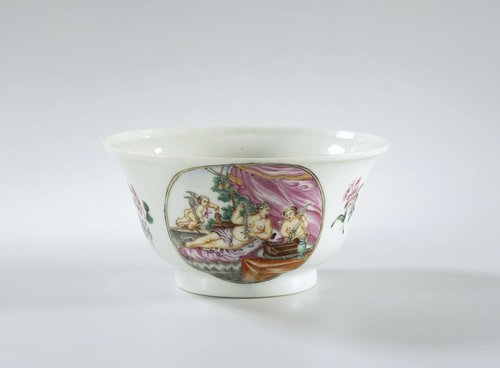
Bell-shaped teacup with Venus and two cupids in two medallions
c. 1770
Medium
turning
Dimensions
12; 6; 5.8
Rights
Public Domain
About this artwork
Klokvormige theekop van porselein, beschilderd op het glazuur in rood, roze, groen, geel, paars, bruin en zwart. Op de buitenzijde twee medaillons met een liggende Venus en twee cupido's in een interieur. Tussen de medaillons twee bloemtakken. Europese voorstelling in emailkleuren.
Art Historical Context
This delicate bell-shaped teacup crafted around 1770, exemplifies the elegance of 18th-century European porcelain Standing just 6 cm tall and 12 cm in, it was likely wheel-thrown ("turning") and fired to create its smooth, glossy form. The exterior is vibrantly painted over the glaze in a palette of red, pink, green,, purple, brown, black enamels—typical of the period's overglaze technique, which allowed for intricate, colorful designs that wouldn't withstand high kiln temperatures. At its heart are two oval medallions: one depicting a reclining Venus in a luxurious interior, symbolizing love and beauty from classical mythology, and the other featuring two playful cupids. Flanking these scenes are delicate flower branches, blending mythological whimsy with naturalistic motifs. This European imagery on porcelain reflects the Rococo taste for ornate, intimate luxury goods, often produced by anonymous artisans in factories like those in Meissen or Sèvres, adapting Chinese export styles for Western audiences. As a teacup from the height of Europe's tea-drinking craze, it highlights porcelain's role as a status symbol, bridging Eastern craftsmanship with Western fantasy. Imagine sipping from it amid candlelit salons—its petite scale and vivid enamels made it both functional art and a conversation starter.
About the Artist
anonymous
In the vast tapestry of art history, "Anonymous" stands not as a singular individual but as a collective designation for countless unidentified creators whose works have endured across millennia. These artists, spanning prehistoric cave painters to medieval illuminators and folk craftsmen, produced the foundational layers of human visual culture. Prior to the Renaissance, when individual fame emer...