
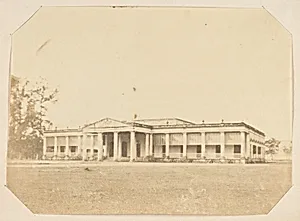
Bengal Artillery Mess House
1850s
Medium
Albumen silver print
Dimensions
Image: 16.8 x 22.9 cm (6 5/8 x 9 in.) Mount: 27.5 x 23.2 cm (10 13/16 x 9 1/8 in.) Print mounted vertically.
Classification
Photographs
Department
Photographs
Museum
Metropolitan Museum of Art, New York, NY
Credit
Gilman Collection, Museum Purchase, 2005
Accession Number
2005.100.948.1 (2b)
Rights
Public Domain
Tags
Art Historical Context
Step into the sun-drenched world of mid-19th-century colonial with this striking albumen silver print of *Bengal Artillery Mess House*, captured in the 1850s by an unknown photographer. Titled simply after its subject, this photograph depicts the grand mess house—a social and dining hub for British artillery officers stationed in Bengal. Measuring 16.8 x 22.9 cm on its, the image is oriented vertically, inviting viewers to gaze upward at the building's imposing colonial architecture, likely a blend of neoclassical and local influences that symbolized British imperial presence. Created during the height of the British Raj, just before the 1857 Indian Rebellion, this print offers a rare glimpse into the daily life and infrastructure of the East India Company's military outposts. The Bengal Artillery, a key force in maintaining colonial control, used such mess houses for camaraderie amid the challenges of tropical service. Albumen silver prints, the era's dominant photographic medium, revolutionized visual documentation with their crisp detail, rich tonal range, and warm sepia hues, achieved by coating paper with egg-white albumen to hold light-sensitive silver salts. Housed in The Metropolitan Museum of Art's Gilman Collection, this work highlights photography's role as an early tool for architectural record-keeping and cultural storytelling, preserving a slice of imperial history for modern eyes.
About the Artist
Unknown
The artist designated as "Unknown" in our virtual museum's collection exemplifies a poignant chapter in art history: creators whose identities have faded into obscurity despite the enduring power of their work. With only one known artwork attributed to them in our holdings, this figure represents countless anonymous hands that shaped visual culture across centuries. Museums worldwide, including th...