
Berenice
1861
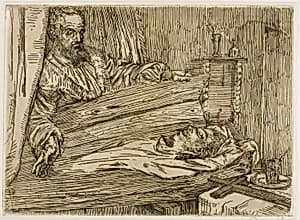
Medium
Etching on ivory laid paper
Dimensions
Plate: 27.3 × 37.6 cm (10 3/4 × 14 13/16 in.); Sheet: 28.2 × 38.4 cm (11 1/8 × 15 1/8 in.)
Classification
etching
Department
Prints and Drawings
Museum
Art Institute of Chicago
Accession Number
104910
Rights
Public Domain
Art Historical Context
Visitors to the Art Institute of Chicago's Prints and Drawings department will delight in *Berenice* (1861), a masterful etching by French-born artist Alphonse Leg. Created when Legros was just 24, this work captures his early prowess in printmaking during a pivotal era in 19th-century French art. Measuring 27.3 × 37.6 cm on the, it exemplifies the intimate scale of etchings, which allowed artists to explore intricate details and textures with remarkable precision. Legros, later became a prominent figure in Britain and associated with Realism—influenced by masters like Courbet—excelled in etching as a medium that bridged painting and print. Etching involves coating a metal plate with acid-resistant ground, scratching lines through it, and immersing in acid to "bite" the grooves, creating rich tonal variations. Printed on luxurious ivory laid paper, *Berenice* showcases the paper's subtle texture, enhancing the image's luminosity and depth, a technique prized by collectors for its velvety quality. This piece highlights etching's role in democratizing art: affordable yet sophisticated, prints like this circulated widely, introducing Legros' realistic style to broader audiences. A gem of technical innovation and artistic ambition, *Berenice* invites you to appreciate the enduring allure of 19th-century print mastery.
About the Artist
Alphonse Legros · 1837–1911
Alphonse Legros (1837–1911) was born in Dijon, France, and trained in Paris at the drawing school of Horace Lecoq de Boisbaudran, whose unconventional teaching method — which emphasised memory drawing and acute observation over academic convention — would leave a lasting mark on Legros's practice. At Lecoq's school he formed friendships with Jules Dalou and Auguste Rodin that endured throughout hi...