
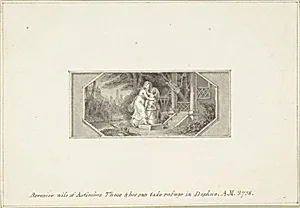
Berenice, wife of Antiochus Theos, and her son take refuge in Daphne
1790–1800
Medium
Pen and brown ink, brush and gray wash
Dimensions
Sheet: 3 1/4 x 4 3/4 in. (8.3 x 12 cm)
Classification
Drawings
Department
Drawings and Prints
Museum
Metropolitan Museum of Art, New York, NY
Credit
Gift of Spencer Bickerton, 1933
Accession Number
33.68.2
Rights
Public Domain
Tags
Art Historical Context
In the late 18th century, artist Edward Francis Burney a dramatic moment from ancient Hellenistic history in this intimate drawing, *Berenice, Wife Antiochus Theos, and Her Son Take Refuge in Daphne* (1790–1800). Burney, alassical draftsman and nephew of novelist Frances Burney, often classical subjects, reflecting the era's fascination with antiquity amid the Enlightenment's revival of Greek and Roman narratives. Here, he illustrates Berenice Syra— of Ptolemy II of Egypt and wife of Seleucid king Antiochus II Theos (r. 261–246 BCE)—fleeing with her young son to the sacred grove of Daphne near Antioch, a sanctuary symbolizing desperate bids for divine protection amid royal intrigues and succession wars. Executed in pen and brown ink with brush and gray wash on a modest sheet (3¼ × 4¾ in.), the work exemplifies preparatory drawing techniques of the period. The fine lines and subtle tonal washes create depth and emotion in a compact format, ideal for studies that could inform larger paintings or prints. Housed in the Metropolitan Museum of Art's Drawings and Prints department (gift of Spencer Bickerton, 1933), this piece highlights women's and children's roles in ancient power struggles, blending historical drama with Burney's precise, evocative style. A window into both ancient refuge and 18th-century artistic imagination, it invites visitors to ponder the timeless human urge for safety.
About the Artist
Edward Francis Burney · 1760–1848
Comment on works: Portraits, history