
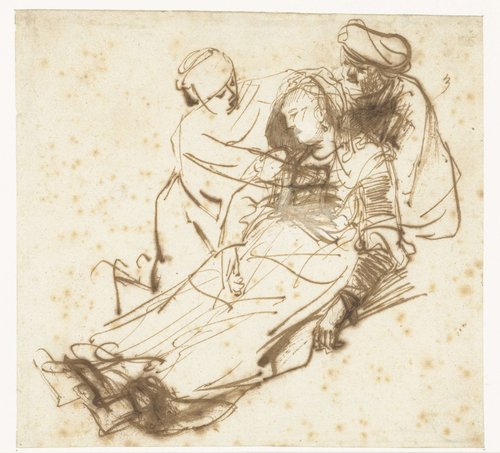
Bewusteloze vrouw, ondersteund door twee figuren
ca. 1640
Medium
pen and brown ink, with opaque white; traces of framing line in brown ink
Dimensions
151; 139
Rights
Public Domain
About this artwork
…; collection Joseph Daniël Böhm (1794-1865), Vienna (L. 271 and 1442); his sale, Vienna (A. Posonyi), 4 December 1865 sqq., no. 1365, as Rembrandt, 17 schillings, to Remigius Adrianus van Haanen (1812-94), Vienna;{Copy RKD.} ...; purchased from H. Lang-Larisch, Munich, with nine other drawings, by Dr Cornelis Hofstede de Groot (1863-1930), The Hague, 1900;{Hofstede de Groot notes, KB.} by whom donated to the museum, 1906, but kept in usufruct; transferred to the museum (L. 2228), 1930
Art Historical Context
Ferdinand Bol's *Bewusteloze vrouw, ondersteund twee figuren* (Unconscious Woman Supported by Two Figures), dating to around 1640, captures a poignant moment of human drama in a compact drawing measuring just 139 x 151 mm. Created during Bol's early career as a promising pupil in Rembrandt's Amsterdam studio, the work depicts a limp woman held aloft by two concerned figures, evoking themes of vulnerability and compassion common in Dutch Golden Age art. Bol, who later became a leading portraitist, here showcases his debt to his master's dramatic chiaroscuro and emotional intensity. Executed in pen and brown ink with opaque white heightening—traces of a framing line suggest it was prepared for presentation—this technique adds luminous depth and volume to the figures, a hallmark of 17th-century Dutch draftsmanship. Such heightened inks were prized for their versatility in studies, bridging sketches and finished works, and reflecting the era's innovative approach to light and shadow. Its provenance adds intrigue: once in the collection of Vienna's Joseph Daniël Böhm and sold in 1865 as a Rembrandt (a frequent misattribution for Bol's Rembrandtesque pieces), it passed through notable hands before art historian Cornelis Hofstede de Groot donated it to the museum in 1906. This small gem highlights Bol's rapid mastery and the blurred lines between master and apprentice in Rembrandt's circle, offering visitors a window into the vibrant world of 17th-century Dutch ateliers.
About the Artist
Ferdinand Bol · 1616–1680
As a very young man, Bol moved to Amsterdam, where he worked under the direction of Rembrandt, with whom he formed a friendship. Comment on works: Religious; History; Portraits