
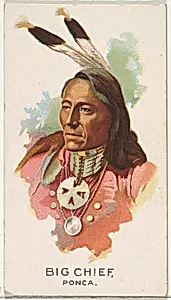
Big Chief, Ponca, from the American Indian Chiefs series (N2) for Allen & Ginter Cigarettes Brands
1888
Medium
Commercial color lithograph
Dimensions
Sheet: 2 3/4 x 1 1/2 in. (7 x 3.8 cm)
Classification
Prints|Ephemera
Department
Drawings and Prints
Museum
Metropolitan Museum of Art, New York, NY
Credit
The Jefferson R. Burdick Collection, Gift of Jefferson R. Burdick
Accession Number
63.350.201.2.15
Rights
Public Domain
Tags
Art Historical Context
Step into the vibrant world of 19th-century American advertising with *Big Chief, Ponca a gem from Allen & Ginter's *American Indian Chiefs* series (N2). Produced in 1888, this petite commercial color lithograph (just 2¾ x 1½ inches) was a promotional insert for their cigarette packs, part of a popular trend where tobacco companies bundled collectible cards to boost sales and captivate consumers. Allen & Ginter, pioneers in the industry, issued these cards during a time when fascination with the American West peaked, fueled by Buffalo Bill's Wild West shows and dime novels romanticizing Native American leaders. Crafted via chromolithography—a groundbreaking technique blending multiple lithographic stones for vivid, mass-produced color—this print showcases the sharp portrait of a Ponca tribe chief, adorned in traditional regalia. Its ephemera classification highlights its everyday origins, yet its preservation in The Metropolitan Museum of Art's Jefferson R. Burdick Collection elevates it to cultural artifact. These cards offered rare glimpses into Indigenous portraits, though often idealized for white audiences, reflecting the era's complex blend of admiration and exoticism. Today, *Big Chief, Ponca* invites reflection on how commerce shaped public perceptions of Native Americans, blending artistry with history in a single, pocket-sized frame.
About the Artist
Allen & Ginter
Allen & Ginter, the pioneering American tobacco firm based in Richmond, Virginia, emerged around 1880 from the partnership of John F. Allen and Lewis Ginter, evolving from Allen's earlier John F. Allen & Company. Allen retired in 1882, succeeded by John Pope, yet the brand endured under Ginter's leadership, employing over 1,100 workers—mostly women—for hand-rolled cigarettes by 1886. Ginter, a Dut...