
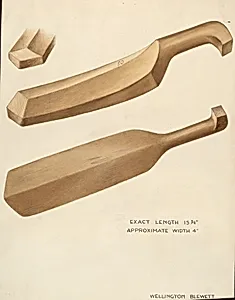
Bishop Hill: Washing Flail
c. 1936
Medium
watercolor, graphite, and pen and ink on paper
Dimensions
overall: 30.4 x 24 cm (11 15/16 x 9 7/16 in.) Original IAD Object: 22 1/2" long; 5" wide; 2" deep
Classification
Index of American Design
Department
CG-W
Museum
National Gallery of Art, Washington, D.C.
Credit
Index of American Design
Accession Number
1943.8.3913
Rights
Public Domain
Art Historical Context
**Bishop Hill: Washing Fl** is a meticulous rendering by Wellington Blew, created around 1936 as part of the Index of American Design (IAD), a Federal Art Project under the Works Progress Administration. This WPA initiative employed artists during the Great Depression to document everyday American folk objects through precise, colorful drawings, preserving cultural heritage at risk of being lost. Blewett's depiction captures a traditional washing flail—an early laundry tool used to beat wet clothes against a surface, removing dirt without modern machinery—from the Swedish settler community of Bishop Hill, Illinois. Bishop Hill, founded in 1846 as a religious utopian colony by Swedish immigrants led by Erik Jansson, became a vibrant hub of folk crafts and traditions. The washing flail exemplifies the practical ingenuity of 19th-century rural life, reflecting the community's self-sufficient lifestyle before industrialization. Blewett's artwork (30.4 x 24 cm) highlights its wooden construction—originally 22½ inches long, 5 inches wide, and 2 inches deep—elevating a humble utilitarian object into a symbol of American vernacular design. Crafted in watercolor, graphite, and pen and ink on paper, the piece combines fine-line details for accuracy with subtle color washes for texture and form, a hallmark of IAD style. Housed in the National Gallery of Art's collection, it invites visitors to appreciate how folk artifacts embody immigrant stories and everyday innovation, bridging art with history.
About the Artist
Wellington Blewett · 1875–1962
**Wellington Blewett (1875–1962)** was a Canadian-born American artist renowned for his meticulous watercolor renderings of everyday American folk objects. Active primarily in the late 1930s, Blewett contributed significantly to the Index of American Design, a Federal Art Project under the Works Progress Administration (WPA) that sought to document the nation's vernacular artistic heritage through...