
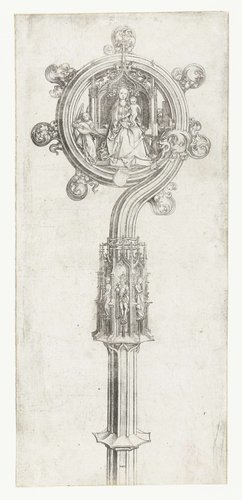
Bisschopsstaf met tronende Maria met Christuskind
1475 - 1480
Medium
engraving
Dimensions
129; 287
Rights
Public Domain
About this artwork
collector's mark: Lugt 240
Art Historical Context
Behold Martin Schongauer's exquisite engraving *Bisschstaf met tronende Maria metkind* (Bishop's Staff withroned Mary and Christ Child), created between 1475 and 1480. This late 15th-century work, measuring 287mm high by 129mm wide, captures sacred design likely intended for a bishop's crozier pastoral staff symbolizing ecclesiastical authority in the Catholic Church. Schongauer a pioneering German artist of the Northern Renaissance, master renders the Virgin Mary enthroned, cradling the Christ Child, evoking tenderness and divine majesty amid intricate Gothic flourishes. As one of the era's foremost engravers, Schongauer elevated printmaking from mere reproduction to a refined art form, influencing masters like Albrecht Dürer. His technique shines here in the precise, delicate lines that convey texture, from the Virgin's flowing robes to the staff's ornate crozier head, achieved through copper plate etching and meticulous burin work. Produced during the height of late Gothic devotion, this piece reflects the period's intense religious fervor, where such images served as devotional aids and status symbols for clergy. Adorned with a collector's mark (Lugt 240), this engraving bridges art and artifact, inviting us to ponder the interplay of faith, craftsmanship, and hierarchy in medieval Europe. A testament to Schongauer's legacy, it remains a gem for admirers of Renaissance innovation.
About the Artist
Martin Schongauer · 1435–1491
Martin Schongauer, born around 1450–1453 in Colmar, Alsace, emerged from a family of skilled artisans. The third of four or five sons of goldsmith Caspar Schongauer, who had relocated from Augsburg to Colmar around 1440, Martin was immersed in the goldsmith's trade from youth, likely receiving his initial training in his father's workshop—a common path for early engravers. He further honed his ski...