
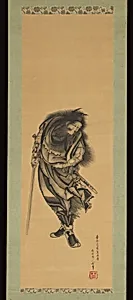
葛飾北斎筆 黒鍾馗|Black Shōki, the Demon Queller
Medium
Hanging scroll; ink on paper
Dimensions
Image: 42 1/4 × 14 3/16 in. (107.3 × 36 cm) Overall with mounting: 72 5/8 × 18 1/2 in. (184.5 × 47 cm) Overall with knobs: 72 5/8 × 20 1/2 in. (184.5 × 52 cm)
Classification
Paintings
Culture & Period
Japan · Edo period (1615–1868)
Department
Asian Art
Museum
Metropolitan Museum of Art, New York, NY
Credit
Charles Stewart Smith Collection, Gift of Mrs. Charles Stewart Smith, Charles Stewart Smith Jr., and Howard Caswell Smith, in memory of Charles Stewart Smith, 1914
Accession Number
14.76.57
Rights
Public Domain
Tags
Art Historical Context
In the late Edo period, master artist Katsushika Hai (1760–1849) created *Black Shōki, the Demon Queller in 1849, one of his final works. This striking hanging scroll, rendered in bold ink on paper, depicts legendary warrior Shōki a fierce protector in Japanese folklore who battles demons safeguards children from evil spirits. Hokusai, renowned for his ukiyo-e woodblock prints like *The Great Wave off Kawa*, showcases his versatility here in traditional sumi-e (ink wash) painting, capturing Shōki's muscular form and determined gaze with dynamic energy. Hanging scrolls like this were prized in Japan for seasonal display during festivals, such as Boys' Day (Tango no Sekku), when images of Shōki symbolized strength and warded off misfortune. The medium of ink on paper allowed Hokusai's masterful brushwork to convey texture and movement—notice the fluid lines of Shōki's robes and the glint of his sword—highlighting his lifelong pursuit of nature's vitality and human spirit. Measuring over six feet with its mounting, this piece from the Metropolitan Museum of Art's Asian Art collection reflects Edo-era cultural reverence for protective deities amid social change. A testament to Hokusai's enduring genius at age 89, it invites viewers to appreciate the blend of myth, power, and artistic precision.
About the Artist
Katsushika Hokusai · 1760–1849
Katsushika Hokusai (1760-1849) stands as one of history's most influential artists, a Japanese master who revolutionized the ukiyo-e woodblock print tradition and profoundly shaped Western art. Born in the Katsushika district of Edo (modern-day Tokyo) to an artisan family, Hokusai lived through nearly nine decades of extraordinary creative evolution, adopting over thirty different artistic names t...