
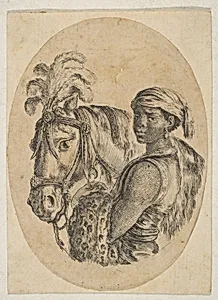
Black slave carries a leopard pelt and holds the bridle of a horse, from "Several heads in the Persian style" (Plusieurs têtes coiffées à la persienne)
Medium
Etching; second state of two
Dimensions
Sheet (trimmed): 4 in. × 3 3/8 in. (10.1 × 8.5 cm)
Classification
Prints
Department
Drawings and Prints
Museum
Metropolitan Museum of Art, New York, NY
Credit
Bequest of Grace M. Pugh, 1985
Accession Number
1986.1180.658
Rights
Public Domain
Tags
Art Historical Context
In the mid-17th century, etcher Stefano della Bella, renowned for his intricate Baroque prints, created this vivid etching as part of his series *Several Heads in the Persian Style*Plusieurs têtes coiffées à la persienne). Produced around 1649–50 and by Israël Henriet, this second-state impression captures a Black slave bearing a luxurious leopard pelt while holding the bridle of a noble horse. The small, trimmed sheet (4 × 3⅜ inches) exemplifies the intimate scale of collector's prints from the era, now housed in the Metropolitan Museum of Art's Drawings and Prints department. Della Bella's etching technique shines here, with delicate cross-hatching and fluid lines rendering textures—from the pelt's spotted fur to the horse's muscular form and the figure's ornate Persian-inspired attire. This work reflects Europe's growing fascination with Eastern exoticism during the Baroque period, blending portraiture, human figures, and equestrian motifs into a stylized "Persian" fantasy. Such prints were popular among intellectuals and aristocrats, serving as both artistic studies and windows into imagined other worlds. Though diminutive, the piece highlights della Bella's mastery of narrative detail in printmaking, a medium that democratized fine art. Bequeathed by Grace M. Pugh in 1985, it invites visitors to ponder 17th-century perceptions of race, status, and cultural hybridity.
About the Artist
Stefano della Bella|Israël Henriet · 1610–1664
Stefano della Bella (1610-1664) was one of the most prolific and versatile printmakers of the Italian Baroque period, leaving behind 1,052 prints and several thousand drawings that captured the vivid essence of 17th-century European life. Born in Florence on May 18, 1610, to a family of artists, he trained initially as a goldsmith before studying painting under Cesare Dandini and etching under Rem...