
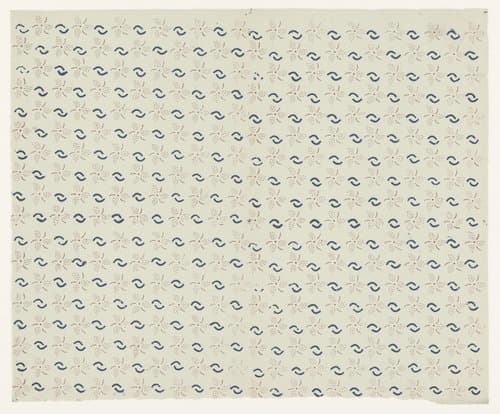
Blad met alternerend strooipatroon van boogjes en bladeren van punten
1800 - 1900
Medium
block printing (relief printing process)
Dimensions
315; 397
Rights
Public Domain
About this artwork
Blad met alternerend strooipatroon van boogjes en bladeren van punten en streepjes.
Art Historical Context
### Blad met Alternerend Strooipatroon van Boogjes en Bladeren van Punten This intriguing anonymous sheet, dating from 1800 to 1900, showcases a delicate alternating scatter pattern of small arches (*boogjes*) and stylized leaves crafted from dots (*punten*) and dashes (*streepjes*). Measuring 315 mm high by 397 mm wide, it exemplifies the everyday artistry of 19th-century decorative design, likely intended as a sample for textiles, wallpaper, or fabric printing. The rhythmic repetition creates a lively, organic motif that would have adorned homes across Europe, blending whimsy with functionality. Crafted via block printing—a relief printing process where intricate designs are carved into wooden blocks, inked, and pressed onto paper or cloth—this piece highlights a labor-intensive technique predating modern mechanized printing. Popular during the Industrial Revolution, such patterns democratized ornamentation, making elegant motifs accessible beyond elite workshops. In Dutch-speaking regions, these designs reflected a growing market for affordable home decor, influenced by floral and geometric traditions. Though created by an unknown hand, the sheet's precision reveals the skill of anonymous artisans who fueled the era's textile boom. It's a charming window into how everyday beauty was printed, one block at a time, transforming plain surfaces into textured tapestries of joy.
About the Artist
anonymous
In the vast tapestry of art history, "Anonymous" stands not as a singular individual but as a collective designation for countless unidentified creators whose works have endured across millennia. These artists, spanning prehistoric cave painters to medieval illuminators and folk craftsmen, produced the foundational layers of human visual culture. Prior to the Renaissance, when individual fame emer...