
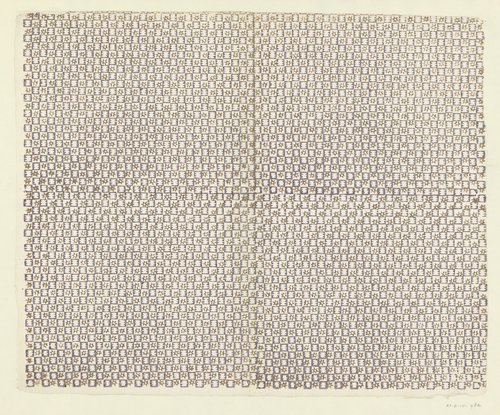
Blad met schaakbordpatroon met uitgespaard motief en ster
1750 - 1950
Medium
block printing (relief printing process)
Dimensions
434; 350
Rights
Public Domain
About this artwork
negatieve en positieve blokdruk in paars en goud
Art Historical Context
This intriguing anonymous print, titled *Blad met schaakpatroon met uitgesard motief en ster (Sheet with Checkerboard with Cut-Out Motif and Star), from between 1750 and 1950. Measuring 350mm high by 434mm wide, it exemplifies block printing—a relief printing process where ink is applied to wooden or linoleum blocks and pressed onto paper or fabric. Likely produced in a European workshop, possibly Dutch given the title's language, this sheet served as a decorative sample, blending timeless geometric motifs like the checkerboard grid, a reserved (cut-out) design, and a central star. The standout technique here is the masterful use of "negative and positive" block printing in vibrant purple and gold inks. Negative areas leave uninked spaces for contrast, while positive impressions build bold patterns, creating a dynamic interplay of light and shadow. This method, rooted in traditional textile and wallpaper production, allowed artisans to achieve intricate, repeatable designs efficiently—ideal for interiors during the Georgian, Victorian, and early modern eras. As an anonymous craft object, it highlights the unsung skill of printmakers who democratized ornamentation across centuries. The checkerboard evokes gamesmanship and balance, while the star adds a celestial or heraldic touch, inviting visitors to ponder its role in everyday luxury or pattern books that inspired homes and fashions. A testament to enduring decorative ingenuity!
About the Artist
anonymous
In the vast tapestry of art history, "Anonymous" stands not as a singular individual but as a collective designation for countless unidentified creators whose works have endured across millennia. These artists, spanning prehistoric cave painters to medieval illuminators and folk craftsmen, produced the foundational layers of human visual culture. Prior to the Renaissance, when individual fame emer...