
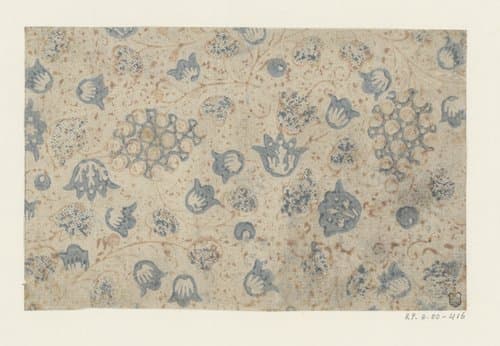
Blad met strooipatroon van ranken met bloemen en druiventrossen
1700 - 1850
Medium
block printing (relief printing process)
Dimensions
120; 189
Rights
Public Domain
About this artwork
Gift of F.G. Waller, Amsterdam
Art Historical Context
This delicate sheet, titled *Blad met strooipatroon van ranken met bloemen en druiventrossen* (Sheet with All-Over Pattern of Tendrils with Flowers and Grape Clusters), showcases an anonymous artist's mastery of repetitive botanical motifs from the 18th or early 19th century (1700–1850). Measuring just 120 × 189 mm, it features an intricate scatter pattern of intertwining vines, blooming flowers, and lush grape clusters, evoking the abundance of nature in a harmonious, repeating design. Likely a sample for textiles or wallpaper, such patterns were staples in European decorative arts, adorning homes and garments with affordable elegance. Crafted via block printing—a relief printing process where motifs are carved in reverse onto wooden blocks, inked, and pressed onto fabric or paper—this technique democratized complex designs. Popular in the Netherlands and beyond during this era, it bridged artisanal craft and emerging industrial production, allowing for vibrant, scalable patterns inspired by exotic imports like Indian chintz. The anonymity highlights the collaborative world of workshops, where skilled printers created timeless motifs without individual fame. A generous gift from F.G. Waller of Amsterdam, this piece offers a window into everyday luxury, reminding us how floral abundance symbolized prosperity and the era's fascination with the natural world in design.
About the Artist
anonymous
In the vast tapestry of art history, "Anonymous" stands not as a singular individual but as a collective designation for countless unidentified creators whose works have endured across millennia. These artists, spanning prehistoric cave painters to medieval illuminators and folk craftsmen, produced the foundational layers of human visual culture. Prior to the Renaissance, when individual fame emer...