
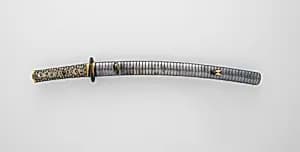
Blade and Mounting for a Short Sword (<i>Wakizashi</i>)
Unknown Artist
blade and mounting, 19th century; sword guard, 16th century
Medium
Steel, wood, rayskin (<i>same</i>), thread, silver, copper-gold alloy (<i>shakudō</i>), gold
Dimensions
L. 22 15/16 in. (58.2 cm); L. of blade 19 11/16 in. (50 cm); L. of cutting edge 15 11/16 in. (39.8 cm); D. of curvature 1/2 in. (1.2 cm)
Classification
Swords
Culture
Japanese
Department
Arms and Armor
Museum
Metropolitan Museum of Art, New York, NY
Credit
H. O. Havemeyer Collection, Bequest of Mrs. H. O. Havemeyer, 1929
Accession Number
29.100.1378a–c
Rights
Public Domain
Art Historical Context
This elegant *wakizashi*, a traditional Japanese short sword, showcases the masterful craftsmanship of feudal Japan. Measuring nearly 23 inches overall, with a sharply curved steel blade of about 20 inches, it features intricate mounting including a hilt wrapped in rayskin (*same*) and silk thread for a secure grip, plus fittings in silver, gold, and *shakudō*—a patinated copper-gold alloy prized for its dark, velvety finish. Notably, the sword guard (*tsuba*) dates to 16th century, while the blade and other elements hail from the 19th century, reflecting how samurai weapons were often heirlooms, repaired, or refitted over generations. In samurai culture, the *wakizashi* served as the companion to the longer *katana*, worn thrust through the sash (*obi*) for close-quarters combat or ritual seppuku. These swords were more than weapons; they embodied the warrior's soul (*tamashii*), symbolizing honor, status, and artistry. The use of exotic rayskin for texture and durability, combined with luxurious metal alloys, highlights the fusion of functionality and aesthetic refinement in Japanese arms. Part of the renowned H. O. Havemeyer Collection at The Metropolitan Museum of Art, this piece invites us to ponder the enduring legacy of the samurai era, where steel met poetry in every curve.