
Blanket or Rug
c. 1900
Medium
Wool, dovetailed tapestry weave; twined edges and ends
Dimensions
308 × 157.5 cm (121 1/4 × 62 in.); Warp repeat: H.: 47 cm (18 1/2 in.)
Classification
textile
Department
Textiles
Museum
Art Institute of Chicago
Accession Number
153685
Rights
Public Domain
About this artwork
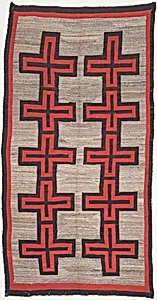
This blanket or rug displays many of the characteristics of Navajo weaving made at the turn of the previous century. During this period, Navajo artists were working in an increasingly commercial environment, with many of their weavings destined for non-Indian buyers. Weavers also could sell their work through traders who would make suggestions on colors and designs in response to market trends. The bold rows of linked crosses are formed using only two colors against a variegated gray background—...
Art Historical Context
This stunning Navajo blanket or rug, by Diné artists around 1900, exemplifies the of Indigenous textile traditions in the American Southwest. Measuring an impressive 308 × 157.5 cm, it served practical purposes as bedding or flooring while doubling as a canvas for cultural expression. By the early 20th century, Navajo weavers had adapted their craft for both personal use and trade, blending utility with artistry amid growing interactions with Anglo-American markets. Crafted from wool using the dovetailed tapestry weave—a signature Navajo technique where wefts interlock precisely at color boundaries for seamless patterns—the piece features twined edges and ends for durability. The warp repeat of 47 cm hints at rhythmic motifs, likely geometric designs symbolic of Navajo cosmology, landscapes, or spiritual narratives. This method, passed down through generations of primarily female weavers, showcases technical precision and aesthetic harmony without a loom's rigid frame. Housed in the Art Institute of Chicago's Textiles Department, this work highlights the enduring cultural significance of Diné weaving. It reflects resilience during a period of rapid change, including U.S. government policies impacting Navajo life, while preserving a vibrant heritage that continues to inspire contemporary artists today.