
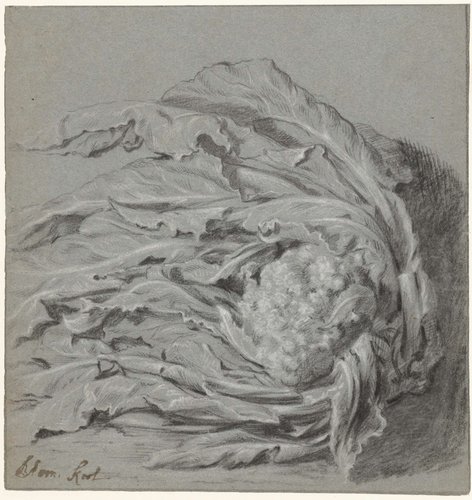
Bloemkool
1600 - 1699
Medium
paper
Dimensions
239; 228
Rights
Public Domain
About this artwork
hoogte 239 mm x breedte 228 mm
Art Historical Context
### Bloemkool (Cauliflower) Step into the quiet elegance of *Bloemkool*, an anonymous artwork from the 17th (1600–1699) that captures the humble beauty of a cauliflower on paper. Measuring a modest 239 mm by 228 mm wide, this intimate piece invites close contemplation, likely serving as a botanical study or still-life sketch. In an era when European artists were increasingly drawn to the natural world, such depictions celebrated everyday wonders amid the scientific curiosity of the time. Created during the Dutch Golden Age's flourish—though the artist remains unknown—this work reflects the period's fascination with precise observation. Paper as a medium was ideal for detailed drawings, allowing portability and experimentation in techniques like ink, watercolor, or pencil that rendered textures vividly. Cauliflowers, exotic imports from the Mediterranean, symbolized abundance and the era's expanding trade networks. Though unattributed, *Bloemkool* offers a window into anonymous craftsmanship, reminding us that not all artistic gems bore famous signatures. Its small scale suggests it was perhaps a personal exercise or collector's item, preserving a slice of 17th-century life for modern eyes. A delightful nod to nature's artistry! (178 words)
About the Artist
anonymous
In the vast tapestry of art history, "Anonymous" stands not as a singular individual but as a collective designation for countless unidentified creators whose works have endured across millennia. These artists, spanning prehistoric cave painters to medieval illuminators and folk craftsmen, produced the foundational layers of human visual culture. Prior to the Renaissance, when individual fame emer...