
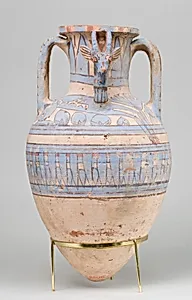
Blue-Painted Ibex Amphora from Malqata
Unknown Artist
ca. 1390–1352 B.C.
Medium
pottery, white cream slip, paint
Dimensions
H. 39.5 × Dia. 12.7 cm (15 9/16 × 5 in.); Largest Dia: 21 cm (8 1/4 in.)
Classification
Amphora, ibex, blue-painted ware
Period
New Kingdom
Department
Egyptian Art
Museum
Metropolitan Museum of Art, New York, NY
Credit
Rogers Fund, 1911
Accession Number
11.215.460
Rights
Public Domain
Tags
Art Historical Context
Step into the opulent world of ancient Egypt with the *Blue-Painted Ibexora from Malqata a stunning pottery vessel dating to around 1390–1352 B.C. during Dynasty 18 of the New. Standing at 39.5 cm tall with a widest diameter of 21 cm, this amphora—likely used for storing oils, wines, or perfumes—features a graceful, elongated form typical of elite Egyptian ceramics. Crafted from pottery coated in a smooth white cream slip and adorned with vibrant paint, its standout decoration is a striking blue-painted ibex, a wild mountain goat symbolizing agility and the untamed desert landscapes revered in Egyptian lore. Discovered at Malqata, the sprawling palace complex of Pharaoh Amenhotep III on the Theban west bank, this amphora reflects the height of New Kingdom luxury and artistry. The blue pigment, evoking the precious lapis lazuli traded from afar, highlights the era's technical prowess in slip painting, where a creamy base allowed bold colors to pop against the vessel's curves. Such vessels were not mere utilities but status symbols in royal households, blending functionality with aesthetic splendor. Today, housed in the Metropolitan Museum of Art's Egyptian Art Department (acquired via the Rogers Fund in 1911), this piece offers a window into Amenhotep III's "golden age" of prosperity and cultural flourishing, reminding us how everyday objects carried profound artistic and symbolic weight in pharaonic Egypt.