
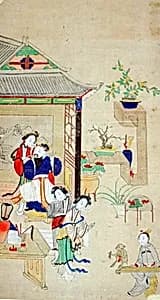
Bo Yi Gao and the White Gibbon Entertain King Zhou
Unknown Artist
19th century
Medium
Polychrome woodblock print; ink and color on paper
Dimensions
Image: 28 3/4 x 15 1/2 in. (73 x 39.4 cm)
Classification
Prints
Culture & Period
China · Qing dynasty (1644–1911)
Department
Asian Art
Museum
Metropolitan Museum of Art, New York, NY
Credit
Harris Brisbane Dick Fund, 1941
Accession Number
CP355
Rights
Public Domain
Tags
Art Historical Context
This vibrant 19th-century polychrome woodblock print from China’s Qing dynasty depicts a lively legendary scene titled *Bo Yi Gao and the White Gibbon Entertain King Zhou*. Created with ink and color on paper, the work measures roughly 28 ¾ by 15 ½ inches and showcases the dynamic figures of a king, attendant women, floral motifs, and the unusual presence of a white gibbon. Such prints were produced through multiple carved blocks, each applying a different hue, resulting in the rich, accessible colors that made these images popular among a wide audience. During the Qing period, woodblock printing served as an important medium for storytelling, preserving historical legends and moral tales for everyday viewers. The subject draws on ancient Chinese lore surrounding King Zhou of the Shang dynasty, whose courtly entertainments were often portrayed in later art as symbols of both splendor and excess. The inclusion of a white gibbon adds a whimsical, almost theatrical element, highlighting the print’s role in blending history with imaginative narrative. Today housed in the Metropolitan Museum of Art’s Asian Art department, this anonymous work reflects the cultural importance of popular prints in 19th-century China. It offers modern visitors a colorful window into how legends were shared and enjoyed across social classes.