
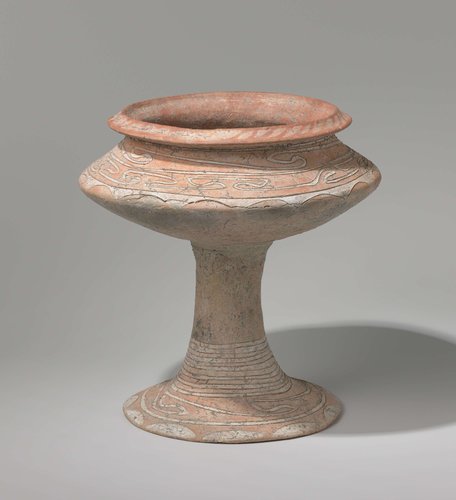
Bokaal op hoge voet met ingegrift spiraalpatroon
ca. -2000 - ca. -1000
Medium
formed
Dimensions
17.4; 23; 16.2; 21.5
Rights
Public Domain
About this artwork
Bokaal op hoge voet van aardewerk met een ondiepe kom en iets uitlopende rand, beschilderd in wit en rood. Op de kom en de voet een ingegrift spiraalpatroon, ingevuld met wit. De rand met rood arceerwerk.
Art Historical Context
This elegant earthenware goblet, standing 23 centimeters tall with a diameter of 17.4 centimeters, dates from roughly 2000 to 1000 BCE. Crafted with a shallow bowl atop a tall, slender foot and a gently flaring rim, it reflects the refined ceramic traditions of prehistoric Europe. Its surface features an incised spiral motif across both the bowl and stem, carefully filled with white pigment, while the rim is accented with delicate red hatching. These decorative choices highlight the maker’s attention to both form and pattern. The use of incised and inlaid decoration on earthenware was a sophisticated technique for the period, allowing the white filling to contrast vividly against the clay body. Spirals appear frequently in Bronze Age art, suggesting symbolic meanings tied to movement, continuity, or natural forces, though their exact significance here remains open to interpretation. The combination of white and red pigmentation further enhances the vessel’s visual impact, indicating an early appreciation for color harmony in functional objects. Likely used for ceremonial or daily purposes, this anonymous work offers a window into the artistic sensibilities of its time. Its balanced proportions and meticulous patterning demonstrate how even utilitarian pottery could serve as a canvas for meaningful design, connecting us to the creative practices of ancient communities.