
Bon Bon Dish
c. 1936
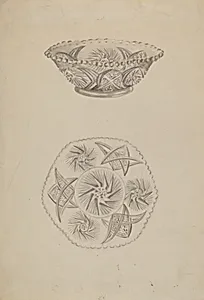
Medium
watercolor, gouache, and graphite on paper
Dimensions
overall: 35.5 x 28 cm (14 x 11 in.)
Classification
Index of American Design
Department
CG-W
Museum
National Gallery of Art, Washington, D.C.
Credit
Index of American Design
Accession Number
1943.8.11289
Rights
Public Domain
Art Historical Context
Eva Wilson's *Bon Bon Dish* (c. 1936) is a captivating watercolor, gouache, and graphite rendering on paper, measuring 35.5 x 28 cm. Created as part of the Index of American Design (IAD), this work meticulously documents a charming American decorative object—a delicate dish for serving confections, likely from the Victorian era or earlier. Wilson's precise graphite outlines paired with the luminous opacity of gouache and fluidity of watercolor bring the dish's intricate patterns, curves, and textures to life, transforming a humble household item into a study of elegant craftsmanship. The IAD, a Federal Art Project under the Works Progress Administration (WPA) from 1935 to 1942, employed artists during the Great Depression to record America's folk art and design heritage. Wilson's contribution preserves the cultural significance of everyday objects like bon bon dishes, which symbolized Victorian hospitality and the artistry of American potters and glassmakers. These renderings, now in the National Gallery of Art's collection, celebrated regional traditions amid economic hardship, fostering national pride in indigenous design. Through her skilled layering of media, Wilson captures not just form but the subtle sheen and ornamentation that defined early 20th-century interpretations of antique wares. This piece invites visitors to appreciate how ordinary items embody America's creative legacy.
About the Artist
Eva Wilson · 1855–present
Eva Wilson is an artist whose biographical details remain largely unrecorded. No confirmed dates of birth or death, geographic origin, or records of formal training have been identified in the historical literature, and her nationality is not definitively established. Her surviving works, held across various collections, indicate a sustained creative practice. The range and volume of pieces attri...