
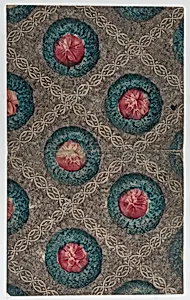
Book cover with circular designs and ornamental diagonal pattern
19th century
Medium
Relief print (wood or metal)
Dimensions
Sheet: 8 7/16 × 13 13/16 in. (21.4 × 35.1 cm)
Classification
Prints
Department
Drawings and Prints
Museum
Metropolitan Museum of Art, New York, NY
Credit
Harris Brisbane Dick Fund, 1940
Accession Number
40.21.111
Rights
Public Domain
Art Historical Context
This exquisite 19th-century book design, created anonymously as a relief print from wood or metal, showcases circular motifs interwoven with an ornamental diagonal pattern. Measuring 8 7/16 × 13 13/16 inches, it exemplifies the era's fascination with decorative symmetry and geometric elegance, likely intended to adorn the front of a bound volume. Housed in the Metropolitan Museum of Art's Drawings and Prints department, it was acquired through the Harris Brisbane Dick Fund in 0, preserving a snapshot of Victorian-era craftsmanship. Relief printing, a technique where the raised surface of a carved block is inked and pressed onto paper or cloth, was ideal for producing repeatable, durable designs for bookbinding. Popular in the 1800s amid the rise of industrialized printing and mass-produced literature, this method allowed for bold, textured patterns that enhanced the tactile appeal of books. The anonymous artist's choice of circles and diagonals evokes balance and movement, reflecting broader 19th-century trends in ornamental arts influenced by revival styles like Gothic or Rococo. Though the specific book it covered remains unknown, this print highlights how everyday objects like bindings became canvases for artistic expression, bridging fine art and functional design during a transformative period in publishing history.
About the Artist
Anonymous
In the vast tapestry of art history, "Anonymous" stands not as a singular individual but as a collective designation for countless unidentified creators whose works have endured across millennia. These artists, spanning prehistoric cave painters to medieval illuminators and folk craftsmen, produced the foundational layers of human visual culture. Prior to the Renaissance, when individual fame emer...