
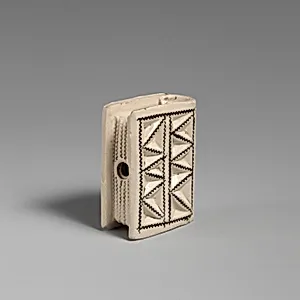
Book flask
Unknown Artist
ca. 1740–50
Medium
Salt-glazed stoneware
Dimensions
2 1/4 × 1 3/4 in. (5.7 × 4.4 cm)
Classification
Ceramics-Pottery
Culture
British, Staffordshire
Department
European Sculpture and Decorative Arts
Museum
Metropolitan Museum of Art, New York, NY
Credit
Gift of Mrs. Russell S. Carter, 1945
Accession Number
45.12.28
Rights
Public Domain
Tags
Art Historical Context
Nestled in the Metropolitan Museum of Art's European Sculpture and Decorative Arts, this charming "Book flask" is a delightful example of mid-18th-century British from Staffordshire, England. Crafted around 1740–50 by an unknown artist, this petite salt-glazed stoneware measures just 2¼ × 1¾ inches, small enough to slip into a pocket or sit discreetly on a shelf. Its book-like form—complete with faux spine, pages, and clasp—transforms a humble flask into a whimsical disguise, likely intended for holding spirits, perfume, or snuff. Salt-glazed stoneware, a hallmark of Staffordshire potteries, was prized for its durability and glossy, orange-peel texture achieved by vaporizing salt in the kiln during firing. This technique allowed potters to create intricate molded shapes affordably, making decorative ceramics accessible beyond the elite. Produced during the height of England's ceramic boom, before Josiah Wedgwood's later fame, the flask reflects the era's playful fusion of utility and ornament, where everyday objects mimicked scholarly books amid rising literacy and Enlightenment curiosity. A gift to the Met in 1945 from Mrs. Russell S. Carter, this tiny treasure invites us to imagine a gentleman's secret tipple hidden in plain sight, blending functionality with subtle humor in Georgian domestic life.