
Book of Chinese Designs, taken from the originals of Persia, of the Indies, of China and of Japan
Medium
Woodcut, engraving, pen and ink
Dimensions
Overall: 21 3/4 x 16 x 1 3/4 in. (55.2 x 40.6 x 4.4 cm)
Classification
Books|Ornament & Architecture
Department
Drawings and Prints
Museum
Metropolitan Museum of Art, New York, NY
Credit
Harris Brisbane Dick Fund, 1940
Accession Number
40.38
Rights
Public Domain
Tags
Art Historical Context
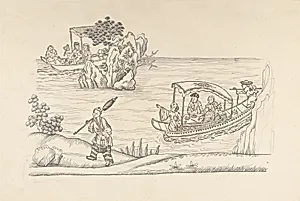
In the opulent world of 18th-century, where curiosity about distant cultures fueled the decorative arts, *Book of Chinese Designs, from the originals of Persia of the Indies, of and of Japan* (1735) stands as a captivating treasure. Created by French artists Jean Antoine Fraisse and-Nicolas Lottin, this volume compiles intricate ornamental motifs drawn directly from Asian and Persian sources. Housed in The Metropolitan Museum of Art's and Prints department, it the era's chinoiserie craze—a European obsession with stylized Eastern aesthetics that adorned furniture, wallpapers, and architecture. Printed using woodcut, engraving, and pen and ink techniques, the book's detailed reproductions allowed widespread dissemination of exotic patterns. Measuring a substantial 21¾ x 16 x 1¾ inches, it features vignettes of men and boats, evoking bustling ports and mythical voyages that bridged continents. These illustrations weren't mere copies; they served as inspirational blueprints for European craftsmen, blending Persian florals, Indian textiles, Chinese lacquers, and Japanese prints into a harmonious fusion. This work's enduring significance lies in its role as a cultural conduit, capturing the Enlightenment's thirst for global knowledge while sparking creative innovation. Visitors today can trace how such designs rippled through Rococo styles, reminding us of art's power to connect worlds.
About the Artist
Jean Antoine Fraisse|Philippe-Nicolas Lottin (French|French) · 1680 | –1739 |
French, active ca. 1680–1739|French