
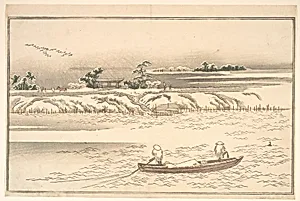
Book of Ehon Ginsekai (The World in Silver)
1754–1806
Medium
Woodblock print; ink and color on paper
Dimensions
9 7/8 x 14 7/8 in. (25.1 x 37.8 cm) (including margins)
Classification
Prints
Culture & Period
Japan · Edo period (1615–1868)
Department
Asian Art
Museum
Metropolitan Museum of Art, New York, NY
Credit
Henry L. Phillips Collection, Bequest of Henry L. Phillips, 1939
Accession Number
JP2853
Rights
Public Domain
Tags
Art Historical Context
Kitagawa Utamaro's *Book of Ehonsekai (The World Silver)*, created during Japan's vibrant Edo period (1615–8), exemplifies the ukiyo-e tradition of woodblock prints that captured the "floating world" of everyday beauty and transience. Utamaro (1754–1806), renowned for his exquisite depictions of women, here turns his masterful eye to landscapes, evoking a shimmering, silvery realm through delicate ink and color on paper. This print, measuring nearly 10 by 15 inches, belongs to a picture book (*ehon*) format, blending artistry with narrative accessibility for a growing urban audience in 18th-century Japan. The composition highlights serene riverscapes dotted with boats, rendered with Utamaro's signature finesse in linework and subtle color gradients achieved through the collaborative woodblock process—carvers, printers, and publishers working in tandem. These techniques allowed for mass production, democratizing art beyond elite circles and reflecting Edo society's fascination with nature's fleeting splendor amid bustling city life. Housed in the Metropolitan Museum of Art's Asian Art collection, this piece from the Henry L. Phillips bequest underscores ukiyo-e's global influence, inspiring later Western artists like Impressionists. Visitors will appreciate its poetic tranquility, a window into Japan's harmonious blend of human activity and natural beauty.
About the Artist
Kitagawa Utamaro · 1753–1806
Kitagawa Utamaro (c. 1753-1806) was one of the most celebrated masters of ukiyo-e woodblock printing, revolutionizing the art of bijin-ga (pictures of beautiful women) during Japan's Edo period. Born Kitagawa Ichitaro, his early life remains shrouded in mystery, with conflicting accounts placing his birth in Kyoto, Osaka, Yoshiwara in Edo (modern Tokyo), or Kawagoe in Musashi Province. Under the t...