
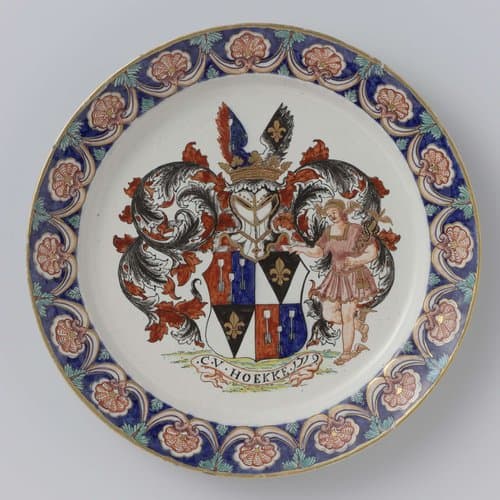
Bord, beschilderd met het familiewapen Cramer van Hoekke
1719
Medium
plate (dishes)
Dimensions
2.6; 24
Rights
Public Domain
About this artwork
opschrift, in banderol, geschilderd in zwart: ‘.C.V.HOEKKE.1719’
Art Historical Context
Step into the world of 18th-century domestic elegance with this charming painted plate, titled *Bord, beschilderd met familiewapen Cramer van Hoekke*. Created anonymously in 1719, this circular dish measures approximately 24 in diameter and 26 cm in height, as a functional yet decorative piece of earthenware. At its center proudly displays the coat of arms of the Cramer Hoekke family, aic emblem symbolizing lineage, status, and pride. Such personalized ceramics were treasured heirlooms, blending utility with artistry in affluent households. The plate's inscription, rendered in black paint on a delicate banderol (a ribbon-like scroll), reads “.C.V.HOEKKE.1719.” This marks it as a bespoke commission or gift, likely commemorating a family event like a marriage, birth, or milestone. In the Netherlands' Golden Age aftermath, ceramics like this—possibly from a regional workshop—inherited Delft's tin-glazed traditions, where overglaze enameling allowed vibrant, durable family motifs. The anonymity of the artist underscores the era's focus on craftsmanship over individual fame. This modest plate offers a window into bourgeois life, where heraldry elevated everyday dining into a statement of heritage. Imagine it gracing a linen-draped table, sparking tales of the Hoekke lineage— a tangible link to the past for modern visitors.
About the Artist
anonymous
In the vast tapestry of art history, "Anonymous" stands not as a singular individual but as a collective designation for countless unidentified creators whose works have endured across millennia. These artists, spanning prehistoric cave painters to medieval illuminators and folk craftsmen, produced the foundational layers of human visual culture. Prior to the Renaissance, when individual fame emer...